



Imagine a caravan of camels moving across an ocean of sand. There are no roads, no signposts, and no GPS—just endless dunes stretching to the horizon. Yet the travelers know exactly where they are going. They navigate by the stars, by memory, and by knowledge passed down through generations.
For centuries, the Tuareg have lived this way.
Known as the “Blue People of the Sahara,” the Tuareg are one of Africa’s most fascinating peoples. Their story is one of legendary desert journeys, mysterious blue veils, warrior queens, haunting guitar music, and a culture that has survived some of the harshest conditions on Earth. Spread across Mali, Niger, Algeria, Libya, Burkina Faso, and parts of neighboring countries, they have long been the masters of a desert that most people would struggle to survive for a single day.
And while outsiders call them the Tuareg, many prefer another name: Imohag—”the free and noble people.”

The People Who Belonged to No Borders
Long before modern states drew lines across maps, the Tuareg moved freely across the Sahara.
Their homeland stretches across one of the largest deserts in the world, from the mountains of southern Algeria to the deserts of Mali and Niger and beyond. For generations, borders meant little. The desert was their world, and they crossed it with remarkable ease.
Today, estimates of their population vary widely, ranging from around three million to more than five million people. Most live in Mali and Niger, while smaller communities are found in Algeria, Libya, and Burkina Faso.
Their lands are among the driest and least populated regions in Africa. To outsiders, these landscapes can seem empty and unforgiving. To the Tuareg, however, they are home.
For centuries, they guided caravans carrying gold, salt, dates, textiles, and other valuable goods across the Sahara. These journeys could take weeks or even months, crossing some of the most unforgiving terrain on Earth.

How the Sahara’s “Blue People” Got Their Name
The Tuareg possess one of the most memorable nicknames in the world.
Their traditional robes and veils are dyed with indigo, a rich blue pigment that stains almost everything it touches. Under the intense Saharan sun, some of the dye rubs onto the skin, leaving behind a faint bluish tint.
Travelers noticed.
Soon, stories spread of mysterious desert nomads whose skin appeared blue, and the nickname stuck: the Blue People of the Sahara.
It sounds almost mythical, like something from an adventure novel. Yet it emerged from a simple combination of fabric, dye, and centuries of desert life.
Even today, the deep-blue garments remain among the most recognizable symbols of Tuareg identity.

The Men Who Hide Their Faces
One of the first things that surprises visitors is that among the Tuareg, it is the men—not the women—who traditionally cover their faces, becoming known as Men of the Veil.
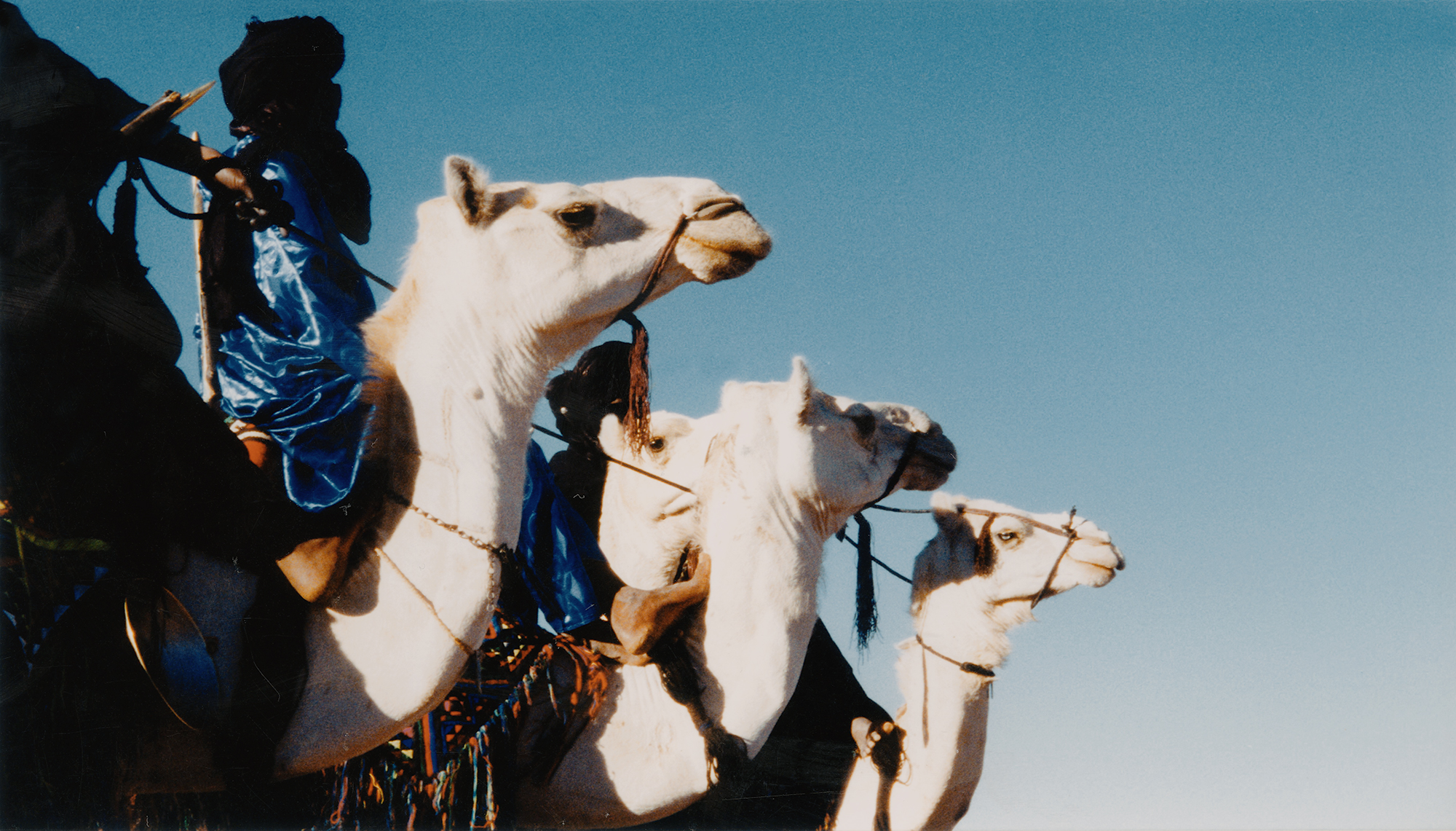
A Tuareg man’s veil, known as the Tagelmust or Takelmoust, can be several meters long and is wrapped carefully around the head and face, leaving only the eyes visible. Traditionally, many men would rarely remove it in public.
Part of the reason is practical. Anyone living in the Sahara quickly learns the value of protection from blowing sand, fierce winds, and relentless sunlight.
But the veil is much more than desert survival gear. For the Tuareg, showing one’s mouth publicly has long been considered improper. The veil is a symbol of dignity, respect, and adulthood. A man earns the right to wear it as he matures, and from then on it becomes part of his identity.
Yet perhaps the most fascinating explanation comes from Tuareg legend.
According to tradition, Ahaggar, the son of the famous queen Tin Hinan, once fled from battle with his army. Ashamed of his actions, he returned home only to discover that the women of the community had defended the fortress in his absence. They had reportedly dressed as warriors, veiled their faces, and fought so fiercely that the enemy retreated.
Unable to face their judgment, Ahaggar covered his face in shame. His soldiers did the same. The custom remained with them for the rest of their lives and was passed on to future generations.
Whether the story is fact, folklore, or something in between, it reveals something important about Tuareg values: honor matters.

A Society Where Women Hold Influence
Many visitors expecting a strictly patriarchal desert society are surprised by the position women hold among the Tuareg.
Women have traditionally enjoyed a degree of freedom uncommon in many neighboring societies. They often play important roles in family and tribal affairs and are respected as keepers of culture and tradition.
Inheritance and family descent have historically followed the maternal line, meaning lineage is traced through mothers rather than fathers.
Women are also central to Tuareg artistic life. They preserve poetry, oral histories, and musical traditions that have been passed down for generations.
It is one of the many ways the Tuareg challenge outsiders’ assumptions about life in the Sahara.

The Sound of the Desert
If the Sahara had a soundtrack, it might sound like Tuareg music.
Traditional Tamasheq music is built around instruments such as the tindé, a drum traditionally played by women, and the imzad, a one-stringed fiddle that is also closely associated with female musicians. Men traditionally contribute singing, handclaps, flutes, and the teherdent lute.
Music accompanies celebrations, storytelling, camel parades, and even sword dances.
In recent decades, however, Tuareg musicians created something entirely new.
Blending traditional rhythms with electric guitars, they developed a genre now known around the world as Desert Blues.
The pioneers were the band Tinariwen, whose songs reflected the struggles, hopes, and political aspirations of Tuareg communities. Formed by musicians who experienced displacement, conflict, and exile, the group’s music became the voice of a generation.
What began in desert camps eventually reached international stages, earning awards and introducing global audiences to Tuareg culture.
Today, artists such as Bombino, Mdou Moctar, Tamikrest, Terakaft, Toumast, and Les Filles de Illighadad continue to carry the tradition forward, blending ancient sounds with modern influences.
Between Tradition and Change
The modern history of the Tuareg has not always been peaceful.
Following the independence of countries such as Mali and Niger, Tuareg communities became involved in a series of rebellions and political movements seeking greater autonomy and recognition. Droughts, economic hardship, and changing political realities have also transformed traditional nomadic life.
Many Tuareg today balance two worlds. Some continue to travel with herds across the desert, while others live in cities, attend universities, and participate in modern economies.
Yet despite these changes, a strong sense of cultural identity remains.
Their language, Tamasheq, is still spoken. Traditional ceremonies continue. Music, poetry, and oral storytelling remain vital parts of community life.

More Than a Nickname
It is easy to be captivated by the Tuareg’s blue robes and veiled faces. Those images have made them one of the Sahara’s most recognizable peoples.
But their story is far richer than a nickname.
They are navigators who crossed deserts before maps existed. Traders who connected distant worlds. Musicians who turned struggle into art. Storytellers who preserved their history through legend and song. And a people who have adapted to centuries of change without losing sight of who they are.
The Sahara may be vast, but few peoples have left a mark on it quite like the Tuareg—the Blue People whose culture remains as enduring and captivating as the desert itself.

We Said This: Don’t Miss… In Pictures: The African Tribe Where Women Rule and Men Are Veiled