


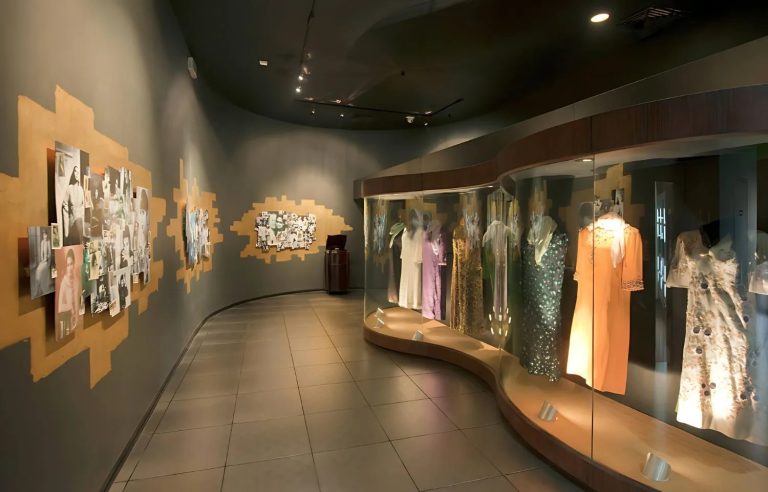
Some of the best ways to get to know the people who shaped the region’s culture don’t always come from history books. Sometimes, it’s as simple as stepping into spaces that preserve their work, personal belongings and stories. From legendary singers and celebrated writers to influential rulers and groundbreaking artists, these museums offer a glimpse into the lives and legacies of some of the Middle East’s most iconic figures. Here are a few worth adding to your cultural bucket list.
Umm Kulthoum Museum – Cairo, Egypt
If there is one voice that instantly transports you to another era, it has to be Umm Kulthoum’s. Located on Cairo’s Rawda Island, the Umm Kulthoum Museum celebrates the life and legacy of one of the Arab world’s most beloved singers. Opened in 1998 in a building attached to Manasterly Palace, the museum brings together some of her most treasured personal belongings, awards, photographs, handwritten lyrics, musical scores, rare recordings and letters.
It also gives visitors a glimpse beyond the legendary voice, exploring Umm Kulthoum’s career, performances, films and relationships with some of the most important cultural and political figures of her time. There are even audiovisual archives featuring her songs, concerts and films, making it feel less like a traditional museum and more like a walk through the life of Kawkab Al Sharq, or “Star of the East.”

Gibran Museum – Bsharri, Lebanon
Tucked away in the mountains of Bsharri, the Gibran Museum offers an intimate look into the world of Gibran Khalil Gibran, the Lebanese-American writer, poet and artist best known for The Prophet. The museum occupies the former Mar Sarkis monastery, which Gibran chose as his final resting place and where his tomb can still be found today.
Inside, visitors can explore his personal belongings, furniture, private library, manuscripts and an impressive collection of 440 original paintings. The museum essentially brings together the different sides of Gibran’s creative life, allowing visitors to see not just the writer behind the famous words, but also the artist behind the paintings.

Taha Hussein Museum – Giza, Egypt
For anyone who loves literature, the former home of Taha Hussein is a pretty special place to visit. Known as the “Dean of Arabic Literature,” the influential Egyptian writer, thinker and academic lived in the villa, known as Ramatan, from 1955 until his death in 1973. It was later transformed into a museum dedicated to his life and work.
The museum gives visitors a peek into the world of the literary icon, from his study and reception room to his bedroom and personal belongings. It also houses around 3,000 books, more than 100 recordings of classical music, his publications and studies, as well as recognitions he received throughout his career. In other words, it is about as close as you can get to stepping into Taha Hussein’s world.

Sheikh Saeed Al Maktoum House – Dubai, UAE
Before Dubai became the futuristic city we know today, its story was shaped by generations of rulers, merchants and families living along the Creek. One of the best places to explore that earlier chapter is Sheikh Saeed Al Maktoum House, the former home of Dubai’s ruler Sheikh Saeed Al Maktoum.
Built in 1896, the traditional coral-and-lime house remained Sheikh Saeed’s home until his death in 1958 and was later opened as a museum. Today, visitors can explore the historic residence while seeing photographs, coins, stamps and documents that tell the story of both the ruler and Dubai during a period of huge transformation.
Lawh Wa Qalam: M.F. Husain Museum – Doha, Qatar
Doha’s Lawh Wa Qalam: M.F. Husain Museum brings the story of one of the most influential modern Indian artists to the Gulf. Dedicated to Maqbool Fida Husain, the museum explores the life and work of the artist, who became a Qatari citizen later in life and spent his final years between Qatar and other parts of the world.
Located in Education City, the museum houses more than 140 original works and personal artefacts spanning Husain’s career, alongside films, sketches, photographs and other archival material. One of its coolest details? The building itself was inspired by a sketch Husain made in 2008 for a potential museum. That original idea was eventually transformed into the colourful, contemporary museum visitors can explore today.

From Umm Kulthoum’s unforgettable voice to Gibran’s poetry, Taha Hussein’s literary legacy and M.F. Husain’s colourful world, these museums prove that getting to know history does not always mean staring at ancient artefacts. Sometimes, it means getting to know the people who helped shape the culture we still enjoy today.
We Said This: Don’t Miss… Taha Hussein Museum Reveals The Mind Of A Genius