

Close Menu
  • عربي
  • Arts
  • Thoughts
  • News
  • Travel
  • Tech
  • Events
  • Business
  • Food
  • Fashion
  • Health
  • Podcasts
  • Events Calendar
Facebook Instagram TikTok WhatsApp YouTube X (Twitter)
  • SCOOP EMPIRE
  • WARA EL MAZZIKA
  • WARA EL CEEMA
  • SCOOP CALENDAR
  • PODCASTS
  • عربي
Facebook X (Twitter) Instagram YouTube LinkedIn TikTok WhatsApp
Scoop EmpireScoop Empire
  • News
    This 11-Year-Old Egyptian Girl Just Won AED 500K at UAE’s Arab Reading Challenge
    October 29, 2026
    Is Netanyahu Staying in Power? Israel’s Election Explained 
    October 28, 2026
    UAE President Awards flydubai Crew for Their Actions During September Flight Incident
    October 28, 2026
    Adam Brody’s ‘Free Palestine’ Statement Sparks Backlash From Pro-Israel Figures
    October 25, 2026
    Pep Guardiola Calls for Solidarity With Palestinians Ahead of BDS Conference
    October 22, 2026
  • Arts
    The Halloween Costumes by Arab Stars We’re Saving for Next Year
    November 1, 2026
    The Egyptian Plays to Catch at Riyadh Season 2026
    October 29, 2026
    6 Egyptian Makeup Artists to Follow for Halloween Inspo
    October 26, 2026
    How Children’s Films From Gaza Inspired Animators Around the World
    October 26, 2026
    Muscat Art Exhibition Is Returning This October for Its Fifth Edition
    October 21, 2026
  • Events
    Public Art Abu Dhabi Biennial Is Turning Streets Into Art Canvases This November
    October 29, 2026
    CairoComix Festival Is Bringing Three Days of Comics and Creativity to Cairo
    October 25, 2026
    Muscat Art Exhibition Is Returning This October for Its Fifth Edition
    October 21, 2026
    Zayed National Museum Is Bringing 7,000 Years of Camel History to Life in a New Exhibition
    October 18, 2026
    Cairo Runners’ Annual Breast Cancer Run Returns to New Cairo This Friday
    October 14, 2026
  • Business
    FIX Dessert Wins Dubai-it Award After Taking Dubai Chocolate Global
    October 25, 2026
    What’s Happening in the Middle East’s Business World This October
    October 19, 2026
    How Meriem Mahrez Turned Her Hair Struggles Into ‘You Are Your Home’
    October 16, 2026
    10 Egyptian Companies That Made Forbes Middle East’s 2026 Fintech 50 List
    October 13, 2026
    Building Leaders, Not Just Careers: The Leadership Philosophy of Dr. Yomna Badr
    October 5, 2026
  • Food
    Coffee Creations in Egypt to Try When a Latte Just Won’t Cut It
    October 27, 2026
    5 Museum Restaurants in MENA Worth the Visit
    October 24, 2026
    Where to Get Your Halloween Desserts in Egypt
    October 22, 2026
    These Cairo Bakeries Serve Breakfast Worth Waking Up Early For
    October 16, 2026
    Fall Drinks Across the Middle East to Add to Your List
    October 15, 2026
  • Travel
    The MENA Cities That Inspired Your Favorite Fashion Designers
    October 31, 2026
    5 Museum Restaurants in MENA Worth the Visit
    October 24, 2026
    MENA Destinations Where You Might Experience Snowfall This Winter
    October 23, 2026
    Dubai’s Outdoor Season Is Back: Here’s Where to Go
    October 14, 2026
    6 Buildings Across the U.S. With Middle Eastern-Inspired Designs
    October 12, 2026
  • Fashion
    A Shoe-Inspired Ring? Christian Louboutin and Emirati TOi Make It Happen
    November 1, 2026
    FENDI Gives Its Iconic Baguette Bag an Emirati Twist
    November 1, 2026
    Gigi Hadid Steps Into Miu Miu’s Holiday Townhouse Fantasy in New Campaign
    October 28, 2026
    Pakistani Label ‘Dreams of Arthur’ Displays Pro-Palestine Message on the Runway
    October 27, 2026
    6 Dubai Fashion Week SS27 Collections That Had Us Looking Twice
    October 26, 2026
  • Health
    6 Wellness Getaways in the Middle East for Your Next Recharge
    October 30, 2026
    How Meriem Mahrez Turned Her Hair Struggles Into ‘You Are Your Home’
    October 16, 2026
    Cairo Runners’ Annual Breast Cancer Run Returns to New Cairo This Friday
    October 14, 2026
    6 Middle Eastern Food Spots Turning Pink for Breast Cancer Awareness Month 
    October 8, 2026
    7 Gyms in Egypt to Visit If You’re Ready to Take Fitness Seriously
    September 8, 2026
  • Sports
    All the Records Lamine Yamal Has Broken Before 20
    October 27, 2026
    Egypt’s Hossam Hassan, Ibrahim Hassan, and Zico Face FIFA Bans
    October 20, 2026
    Palestinian Karate Champion Mariam Bsharat Wins Back-to-Back World Titles
    October 19, 2026
    Mohamed Salah’s Biggest Achievements Since Joining Trabzonspor
    October 12, 2026
    Syria Hosts the Arab Cycling Championship Again After Nearly 20 Years
    October 5, 2026
  • Tech
    6 Egyptians Nominated for the Women in Tech MENA Awards 2026
    October 20, 2026
    WHOOP Just Launched Its App in Arabic: Here’s What to Know
    October 14, 2026
    10 Egyptian Companies That Made Forbes Middle East’s 2026 Fintech 50 List
    October 13, 2026
    AI Teacher Avatars Could Soon Be Coming to Schools in Dubai
    September 28, 2026
    Meet the Robots Turning the Middle East Into a Sci-Fi Movie
    September 25, 2026
  • Thoughts
    11 Guinness World Records Set by Arabs in 2026
    October 17, 2026
    Why These Egyptian TV Villains Keep Stealing the Spotlight
    October 3, 2026
    How One Gazan Artist Is Bringing Color to UNICEF School Bags
    October 2, 2026
    Florence Pugh Opens Up About Her Continued Support for Palestine
    September 27, 2026
    How Gazans Are Finding Ways to Hold On to Everyday Life
    September 16, 2026
Scoop EmpireScoop Empire
You are at:Home»Arts»Unique & Unusual Musical Instruments From The Middle East
Arts

Unique & Unusual Musical Instruments From The Middle East

Thomas PinnBy Thomas PinnJuly 31, 2022Updated:November 19, 20238 Mins Read
Facebook WhatsApp Twitter LinkedIn Pinterest Email
Unique & Unusual Musical Instruments From The Middle East
Share
Facebook Twitter LinkedIn Pinterest WhatsApp Email

The Middle East is renowned the world over for its rich cultural history, and in particular its music, from the mesmerizing lyrics of Abdel Halim Hafez to the tantalizing voice of Um Kalthoum. Thing is, behind the distinctive and often arresting voices of those great singers of the region is the sound of musical instruments unique to the Middle East that open up new modes of expression and feeling. These unique and often unusual instruments have helped give the region its unique sound and have enabled genres in the region to experiment with melodies, rhythms, and tones, otherwise impossible on instruments from elsewhere in the world.

The sad part is that many of these old and unusual instruments seem to be slowly disappearing from popular culture, or have already been mostly forgotten about outright. In today’s music scene, many traditional instruments have been replaced with guitars, keyboards and other instruments. That is why we wanted to revive and shine a light on the region’s most unique and unusual musical instruments that originated from the Middle East and North Africa.

Simsimiyya

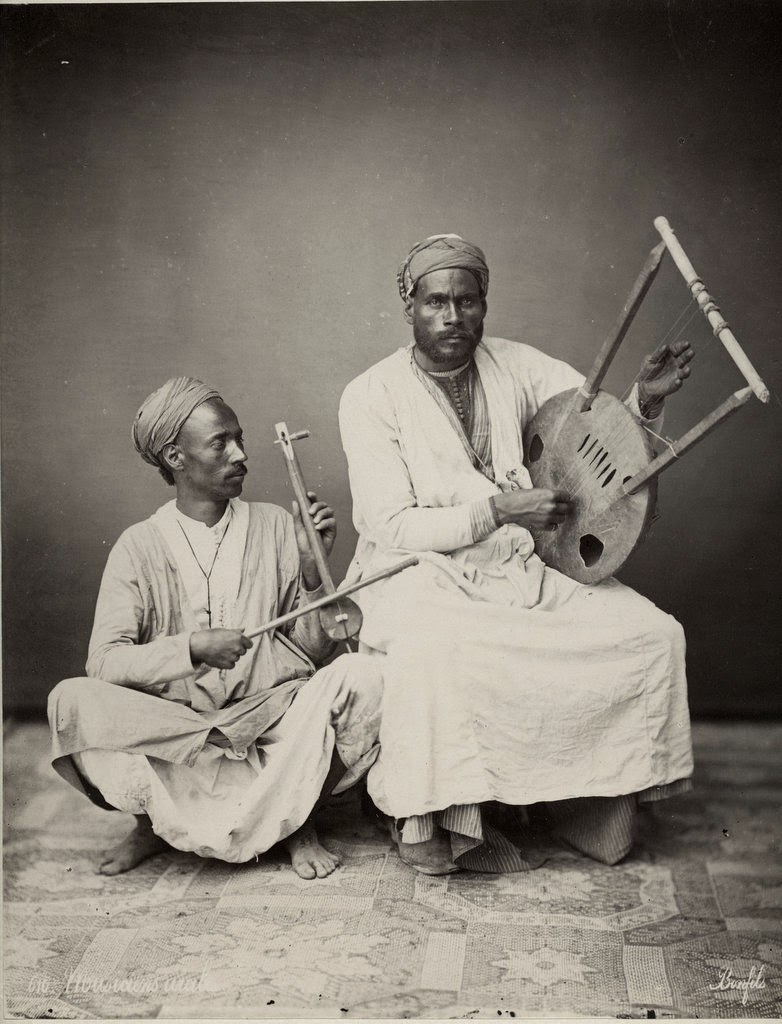
Also known as the Egyptian lyre, the simsimiyya can trace its origins all the way back to ancient Egypt. While several pharaonic tomb paintings have featured simsimiyyas and several have been unearthed from the sands and now housed in museums, this native Egyptian instrument was played throughout the Islamic period and is even played today, especially by musicians in Egypt’s Port Said. The instrument is believed to have been introduced to Lower Egypt by Nubians who brought it with them when they were enlisted to help build the Suez Canal in the nineteenth century.
Advertisement
Simsimiyya on the right. Via Pinterest.

The simsimiyya quickly became a hugely popular instrument used in the folk genre knows as sawahli, which translates as coastal, referring to the coast of Egypt facing the Mediterranean. The simsimiyya is still proudly part of Egypt’s folk culture and is still played in performances in Port Said and Ismalia and surrounding villages, often accompanied by a traditional dance known as bambutiyya.

Manjur

One of the Middle East’s most unique and odd musical instruments is a percussion instrument called a manjur. The manjur is a cloth covered in goat hooves that is tied to someone who then shakes and moves their hips so the hooves knock into each other and create a rattling and clanking sound. This unusual instrument can primarily be found in Oman, UAE, Qatar, and eastern Saudi Arabia and is often used in fann at-tanbura (traditional dance and music genre of the gulf) performances. They are also popular in Zar performances, where the singer and dancers would enter into a trance to ward off evil spirits.

Manjur at the Bait Al Baranda Museum in Muscat, Oman. Via Wikipedia.

Qanun

The qanun’s legendary difficulty and the strict rules that have to be followed to produce the instruments famed melodramatic sounds gave the instrument its name, qanun, which roughly translates into Arabic as rules. The origins of this special instrument go back to before the time of Christ, and to the ancient civilizations of Anatolia, Mesopotamia and Egypt. It went on to be an incredibly popular instrument across the region, continuing on through the Islamic period, and until today for classically-trained musicians. Mastering the 81 strings of the qanun is no easy feat, but its sound is quite special and something to listen to live if you ever get the chance at a local cultural centre or opera house.

Illustration of Palestinian qanun player. Via Wikipedia.

Kamancheh

Spilling over the borders of the Middle East, the kamancheh is a popular and widely played instrument played throughout central Asia and also in Iran, Iraq, and Kurdistan, with very similar instruments also played in Turkey. This unusually shaped instrument with its thick stumpy neck and sheepskin-covered drum takes its name from the Persian word for little bow and as of 2017 has been recognized by UNESCO as part of its Intangible Cultural Heritage List. Often beautifully inlayed with ivory or pearl, a kamancheh is a work of art in and of its and its sustained sound has often been described as being akin to that of a human voice.

Musician playing the kamancheh. Via Encyclopedia Iranica.

Mihbaj

The mihbaj is a very peculiar instrument that works both as a percussion instrument and a coffee grinder. Although its main function is to grind coffee, through its large and heavy foot-long pestle and large mortar, it also makes for a great a percussion instrument. The mihbaj is one the few instruments used in Bedouin music and has a unique sound quite unlike any other instrument. Members of the Druze community also use this instrument in rituals and produce some incredibly unexpected sounds and rhythms.
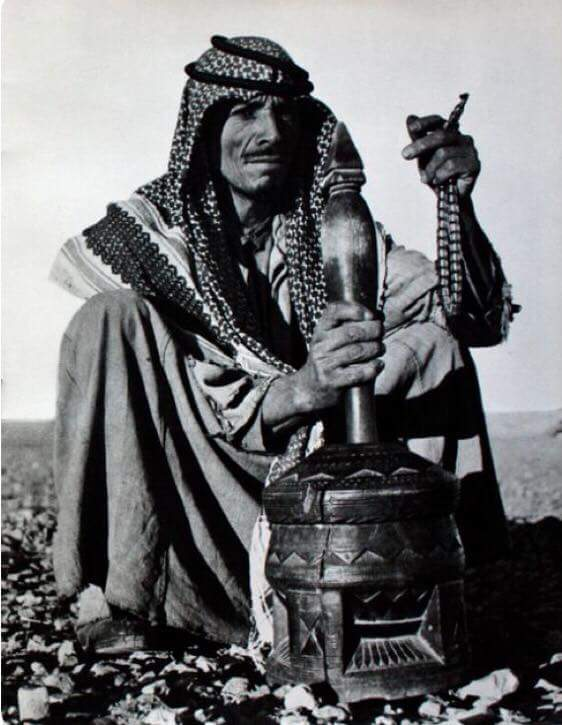
Bedouin musician playing the mihbaj. Via The Bedouin.

Rebab

The slim and thin rebab, played by either plucking or with a stringed bow, spread throughout Islamic trading routes and established itself as an important folk instrument all the way from parts of Europe to the Middle East and even parts of South East Asia. While its limited range meant that the rebab was quickly pushed aside by the introduction of the violin, some Bedouin musicians still use this ancient instrument throughout the Middle East. Outside of isolated communities and museums, its hard to come across rebabs, but its influence on the development of music worldwide and the development of musical instruments, the violin primarily among them, is hard to underestimate.
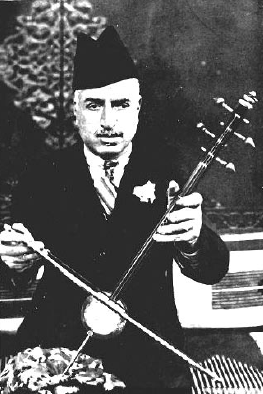
Iraqi musician Salih Shemayil playing the Rebab at the Cairo Congress of Arab Music in 1932. Via Wikipedia.

Santur

Is it a drum? Is it a lute? No, its a santur, an incredibly unique stringed instrument that is played with small hammers. With stone carvings from eighth century BC Mesopotamia depicting santur players, the santur is one of the world’s oldest instruments, although at that time it was played hung from the neck as opposed to on the lap. Through trade and travel, the sintur spread throughout the Middle East and it is said that the Chinese yangqin and European hammered dulcimer owe their origins to the santur, along with other similar instruments from every corner of the globe, with the notable exception of South America. The santur, as like many other early instruments, are a reminder of a shared cultural heritage that much of the world has.
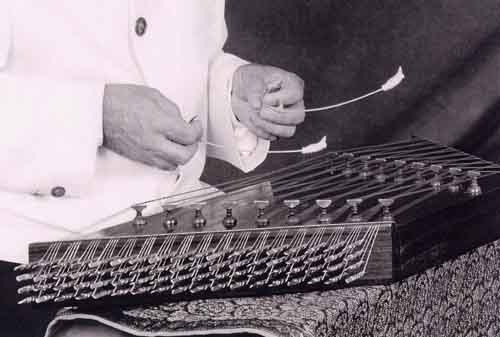
Santur. Via Wikipedia.

Sintir

In Morocco, an ethnic group known as the Gnawa, use a three-stringed banjo-like instrument with an animal skin-covered drum known as the sintir. The deep and powerful sound of the strings is accompanied by drumming the base and has traditionally been used in the group’s sufi rituals. The sintar is said to create a trance-like rhythm very much unlike other musical genres in the world, giving it an incredibly unique sound and feel. The sintar and the Gnawa’s unique musical sound has gained world-wide attention and there are now several annual music festivals to help preserve and celebrate this unique musical contribution.

Moroccan street musician playing the sintir. Via Flickr.

Mizwad

Mizwad is the Tunisian version of the Scottish bagpipes, whose name translates from Tunisian Arabic to the very unglamorous title of sack or food pouch. The windbag made from sheep leather is placed below one arm while the player blows and presses their fingers on and off holes to produce the desired tone. Often accompanied by a drum, the mizwad is mostly a rural and working class instrument played at weddings and dances and is thankfully very much still part of a living and breathing culture.

Miwad player. Via Wikipedia.

Arghul

If you thought the flute was a bit too simple for you, why not try two flutes at the same time? The arghul is incredibly difficult to play and traces its history back to ancient Egypt, yet is still used in folk music in Palestine, Syria, Jordan, and Egypt. In these countries, the arghul usually accompanies dabke and folkloric belly dancing. With one pipe for the melody with holes and another pipe for sustained drones whose sliding body alters the pitch, the arghul is a one-man band type of instrument.

Argul with bell attached. Via Wikipedia.

By learning about each of these instruments, we all get the chance to tap into the region’s rich history and culture as well as how it changed and transformed in the years that followed. Beyond the differences, a lot of us can also appreciate how many of today’s instruments are derived and inspired by these old and traditional tools of music.

WE SAID THIS: The Middle East’s Influence On Modern Western Music: A Perspective

Arab Instruments Middle East Music unique unusual
Previous ArticleA Unique Addition to Egypt’s Sahel Line-Up: Faouzia
Next Article 2 Men Arrested In Dubai Mere Moments Before Flight Liftoff In Connection To Heist
Thomas Pinn
  • Facebook
  • X (Twitter)
  • Instagram

Thomas can often be found taking walks throughout Cairo in search of the weird and wonderful. He is interested in local histories and is studying for a Master's in international relations with a particular focus on Cairene urban development and heritage conservation.

Advertisement

Related Posts

The Halloween Costumes by Arab Stars We’re Saving for Next Year

November 1, 2026

FENDI Gives Its Iconic Baguette Bag an Emirati Twist

November 1, 2026

This 11-Year-Old Egyptian Girl Just Won AED 500K at UAE’s Arab Reading Challenge

October 29, 2026

Comments are closed.

Theatre events in MENA

  • 4NovReflective Parenting WorkshopDbayeh · EVLOVE Center11:00 am
  • 4NovRedeeming LoveCairo · Falaki Theater8:00 pm
  • 5NovRedeeming LoveCairo · Falaki Mainstage Theater8:00 pm
  • 5NovThe MembersRiyadh · The Med9:00 pm
  • 7NovL’Effet PapillonTunis · Lartisto théâtre et cinéma7:30 pm
See all upcoming events →
Follow Us
  • Facebook
  • Instagram
  • TikTok
  • YouTube
  • Twitter
  • WhatsApp
  • LinkedIn
Advertisement
Scoop Empire

Stories from the Middle East

Facebook Instagram TikTok YouTube WhatsApp X (Twitter) LinkedIn

Sections

  • News
  • Arts
  • Events
  • Business
  • Food
  • Travel
  • Fashion
  • Health
  • Sports
  • Tech
  • Thoughts

More

  • About
  • Contact Us
  • Scoop Team
  • Careers
  • Terms & Conditions
  • Privacy Policy
  • بالعربي

© 2026 Scoop Empire. Made in Cairo with ♥︎.

Scoop Empire Universe

Type above and press Enter to search. Press Esc to cancel.