


After three long and depressing days of Israeli airstrikes pommeling the Gaza Strip, a ceasefire was finally brokered. As funerals are held for the 46 killed in the airstrikes, 16 of which were children; Gazans are left to mourn the dead and again try to rebuild their homes and workplaces. Unfortunately, many allege that this all-too-familiar tale of indiscriminate bombing of civilians and ever-depressing disproportionate use of force could refer to any one of the numerous aggressions faced by those in the Gaza Strip since 2007, and, sadly, will almost certainly describe many future tragedies that they will suffer.
Palestinian activists argue that in the face of rising Israeli nationalism that no longer pays lip service to a two-state solution, the very existence of Palestine is under threat as illegal settlements further encroach on the Palestinian territories in the West Bank and Gaza is pushed ever more into a state of uninhabitability. However, one way Palestinians, and in particular Gazans, have fought back against the cultural erasure of the Palestinian identity has been through the preservation of Palestinian culture and its archaeological heritage dating back five millennia.

Archaeology as Resistance
The Nakba of 1948 saw the destruction of more than 400 Palestinian towns and villages and men, women, and children were forced to flee as tales of militias committing atrocities up and down Palestine spread fear throughout the population. The Nakba, however, not only displaced millions of Palestinians and led to the tragic death of thousands, but it also served the purpose of systematically erasing Palestinian heritage, as shrines, homes, and the remnants of traditional Palestinian life were destroyed. Following the creation of the state of Israel, critics allege that the field of archaeology increasingly became a battleground and tool of the Israeli state to exclude Palestinian heritage and present an exclusionary historical narrative. In Jerusalem, Nablus, Hebron, Bethlehem, and many other historic centers, buildings that attested to Palestine’s vibrant history of being home to many ethnic and religious communities were either destroyed or left to slowly dilapidate by the Israeli state. While on the other hand, archaeological projects and museums that only highlighted a particular part of Palestine’s history received huge amounts of investment and support from the Israeli state. Palestinian activists argue that the truth is that Palestine has been the historical home to Muslims, Jews, Christians, and various polytheistic faiths dating back six thousand years; it does not belong to one religion but is the ancestral home of many diverse communities. As such, Palestinians have increasingly used archaeology and the preservation of uniquely Palestinian cultures as a way to fight back a narrative constructed by the Israeli state that disempowers Palestinians’ claim to their deep-rooted heritage. In the embattled Gaza Strip, civil society groups along with amateur historians and archaeologists have long been trying to preserve and document their heritage through several projects, and have recently been joined by the initially oppositional Hamas-led local government in their efforts.
Unearthing Ancient Civilisations
The artillery shells and missiles that have churned up the soil of the little-remaining farmland in this besieged territory and Palestinian farmers that dig to plant crops and build wells; however, have also unearthed many archaeological treasures. Recently, a farmer in the south of the strip came across a stone statue hidden beneath the ground, which as the mud was washed away, revealed itself to be Anat wearing a serpent crown, the Canaanite god of war, love, and beauty. Gazan humor was quick to comment on the unfortunate irony of unearthing a 4500-year-old statue of the god of war in the besieged Gaza Strip. However, finds such as these in Palestine take on explicitly political importance, as they instill a sense of national belonging and collective ancestry. Expanding on this point, an official of the Gazan Ministry of Tourism and Antiquities said in a press conference announcing the discovery of the Anat statue, “Such discoveries prove that Palestine has civilization and history, and no one can deny or falsify this history … this is the Palestinian people and their ancient Canaanite civilization.”

In another testament to Gaza’s rich history, often only hidden just under the surface; in 2013, a Gazan fisherman noticed a lifeless body in the sea half buried under the sand, appearing to be badly burnt. Horrified at the prospect of finding a body, but feeling a duty to retrieve or at least identify the body, he dived down to try and bring up this body from the depths. However, he was immediately confronted with the great and unexpected weight of the body that couldn’t possibly be human, how it felt like stone or some sort of metal, and how the unusual color of the body from the surface had led him to believe it was badly burnt, on closer inspection revealed streaks of turquoise blue and gold. To his relief, the lifeless body was that of Apollo, the Greek god of love, expertly sculpted in bronze.

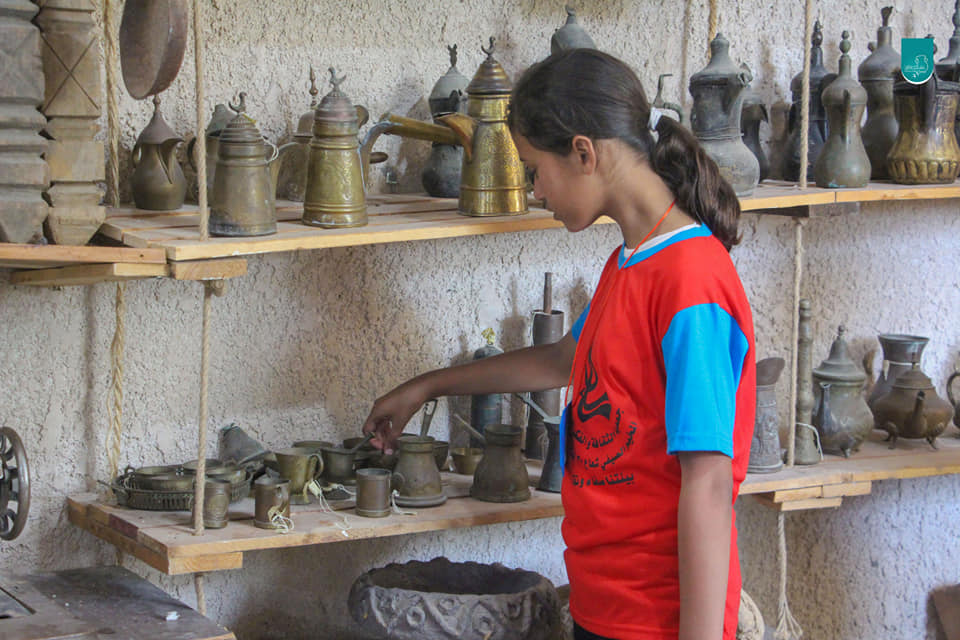
One inspiring example of the many citizen-led cultural preservation projects is the Qarara Cultural Museum set up by a married couple, Mohammad and Najla. The couple who say their “feelings for each other are only paralleled by their love for Palestine”, began by digging up artifacts in Gaza and displaying them in a small and humble house to highlight the numerous civilizations that Gaza hosted over five millennia and to preserve a uniquely Palestinian cultural heritage. Realizing the importance of preserving Palestine’s history and sharing in a mutual pride in its people’s deep roots, farmers who happened across artifacts in their fields while planting crops and amateur archeologists soon began to add to the Qarara Cultural Museum’s collection.

Now, the make-shift museum houses approximately 3000 objects that date back from the Canaanite, Roman, Byzantine, and Islamic periods, and even contains objects from Palestine’s more recent history under occupation by the British Empire as a testament to Gaza’s diverse history. Among its impressive Roman crowns and Byzantine pillars, is its particularly important collection of traditional Palestinian clothes, agricultural tools and other examples of everyday Palestinian life dating back thousands of years that lay an irrefutable claim to the land. The museum has become a vibrant cultural center hosting events and school trips to preserve Palestinian heritage and educate younger generations about a proud history before the Nakba. Mohammad has told news organizations that the idea to create the museum was not only to protect artifacts from theft but also to counter attempts to erase Palestinian culture and distort the nation’s history by the Israeli state.

However, with Gaza’s two million people struggling to live in this cramped 300-square-kilometer strip, the importance of available land for housing or farmland is hard to underestimate. As such, it is understandable that many archaeological finds are seen by many as secondary importance to this besieged population struggling both economically and for space to build houses and grow crops. Numerous reports detail how several archaeological discoveries in the Gaza Strip have been covered up by developers worried that they will receive no monetary compensation from any work stoppage or potentially be left bankrupt if the site is deemed too important to be built upon. However, in an encouraging development, the recent discovery of 40 Roman tombs at a building site led to the immediate halt of all construction work so the tombs could be investigated and protected. Specialists from Premiere Urgence Internationale soon announced that among the tombs was one colorfully painted with depictions of plants and crowns and that they believed there were maybe another 60 tombs in the area yet to be uncovered. Commenting on how the importance of such sites goes beyond their pure archaeological value, Jihad Abu Hassan, a senior official of the Premiere Urgence Internationale, argued, “The image of Gaza is often associated with violence, but its history is bursting with archaeological treasures that need to be protected for future generations”.

Palestine and the Gaza Strip as a Home to All Faiths
Churches and mosques dating back centuries along with other sights of great historical importance have also suffered under the recurring Israeli airstrikes, with their roofs caved in by shelling and even mosaics churned up by the tracks of Israeli tanks. However, recent efforts in the Gaza Strip have concentrated on these ancient religious sights, partly in a bid to counter Islamophobic narratives of Palestine as a religiously intolerant and uniquely Islamic entity.

The Saint Porphyrius Church, which hosts Gaza’s Greek Orthodox community, has recently come under special attention from local civil society groups as a place in need of protection. Highlighted as a beautiful example of Gaza’s diverse and deep-rooted history, the 1600-year-old church is proudly seen as a living example of Palestine’s continuing diversity. The importance of the church is incredible to Gazan Christians themselves who are prevented by the Israeli blockade from being able to easily travel to other parts of Palestine to take part in other religious services or pilgrimages. For Christians aged 16 to 35 especially, they are not allowed to travel to the West Bank to attend religious ceremonies under any circumstances and the Saint Porphyrius Church is one of the few places available for them to practice their faith.

Restoration work at the Saint Hilarion Monastery in Gaza has uncovered the most impressive mosaics and a labyrinth of rest houses, bathhouses and crypts that made up this pilgrimage site in its heyday from the late Roman period to the Umayyad period. While known locally in Arabic as Tell Umm el-Amr, the monastery is named after the Gaza-born Hilarion the Great, understood to be the founder of Palestinian monasticism. However, while being so inescapably of Gazan heritage, unfortunately up to as much as 60% of the artifacts from the site, including gold and copper items left behind the monks and impressive marble columns, have been taken outside of Gaza. Between 1990 until the creation of the Palestinian Authority in 1994, Israeli archaeological missions transferred numerous of the most valuable items from the monastery out of Gaza and housed them at the Rockefeller Museum in Jerusalem. Due in large part to Israel’s absolute refusal to return these items, which the Palestinian Authority describe as stolen, efforts to preserve what is left and what is waiting to be found at Tell Umm el-Amr have taken on ever greater importance for Gazans wishing to proudly preserve and display their heritage.

Along with numerous historically significant places of Christian history in the Gaza Strip are several mosques and madrassas that date back to the fifth century AD. The most notable is the Great Omari Mosque, which is the largest and oldest to be found in Gaza. This unique example of early Islamic architecture has been painstakingly preserved and still hosts prayers attended by thousands.

The challenge faced by Gazans trying to preserve their heritage is further increased by the difficulty of importing vital specialist equipment needed to restore buildings and protect historical sights. Due to the Israeli blockade, even the most basic tools are impossible to acquire and archaeologists have often been forced to create their own tools locally. Further, the lack of foreign specialists able to easily to cross into the Gaza Strip and help with ongoing projects has meant that archaeological projects in Gaza have often struggled without certain expertise.
Palestine’s Mamluk and Ottoman Heritage
Gaza is also home to roughly 300 Mamluk and Ottoman houses and bathhouses in varying states of disrepair, which despite often being subject to Israeli bombardment or the threat of demolition, are argued by many in Gaza to be part of an irreplaceable heritage that must be preserved. In 2020, artists and conservationists from the community began to restore the 500-year-old Al-Kamalaia School in Gaza City’s old quarter and turn it into a cultural venue. This is but one of many examples in Gaza that despite the lack of funding and heavy reliance on the labor of young volunteers have attempted to protect architectural gems in the city from destruction and repurpose them as places to foster community and host events.


The Ghussein Palace is another example of a grassroots organization in Gaza teaming up to preserve Gazan heritage. This beautifully restored Mamluk home and courtyard is a portal to a period when Gaza was considered to be one of the most important trading ports in the region and gives an insight into how life used to be. However, as with many conservation projects throughout Gaza, the success of such projects in the face of a lack of funding and reliance on unpaid volunteers is a testament to the dedication of the Gazans to preserve and protect their heritage.

The head of the Canaanite goddess of war and beauty, Anat, mentioned previously, is now on display at one of the Gaza Strip’s only museums, the Qasr al-Basha. Qasr al-Basha is an impressive Mamluk-era, which is another important historical relic that has been saved from collapse. The building’s core which dates back to the thirteenth century is said to have been a residence for Sultan Baybars, in particular for his Gazan wives, before being used as the residence of later Ottoman provincial governors and supposedly housing Napoleon for several nights during his military conquests in the region. More recently, Qasr al-Basha had been used as a police headquarters by the British and later a school for girls following the evacuation of the British from Palestine. After extensive renovation works, the Mamluk building was opened as a museum displaying Palestinian heritage and artifacts dating back six thousand years and remains one of only a handful of museums in Gaza celebrating its heritage.

Securing the Future through the Past
While the Hamas-run administration heading the Gaza Strip has been previously criticized for its own disregard for its pre-Islamic archaeological heritage. Most notably with the ruins of Tell as-Sakan, a port and fortified settlement that dates back over 5300 years all the way to 3300 BCE, which was demolished in 2017 to make way for a military development of some sort. The local government has been successfully pressured by local civil society groups to support efforts to preserve the archaeological heritage of the Gaza Strip, and in June 2022, the Ministry of Tourism and Antiquities in the Gaza Strip released its own illustrated guide to Gaza’s archaeological sights.
However, many of the archaeological sites in Gaza still remain incredibly vulnerable and the multiple challenges faced by those trying to preserve Gaza’s archaeological and cultural heritage are hard to overcome. Yet despite this, efforts to preserve Gaza’s heritage have only increased and Gazans have found a newfound pride in their culture and heritage. As a testament to this, every year on October 7, the streets of Gaza erupt with the joyous sounds of drums, clapping, and children playing for Palestine Heritage Day. With old men and women donning their finest traditional outfits and groups of young people dancing dabke, Gazans celebrate their heritage through song, dance, and poetry.
WE SAID THIS: Don’t Forget… Preserving Heritage And Building Communities At Historic Cairo’s Bayt Yakan