


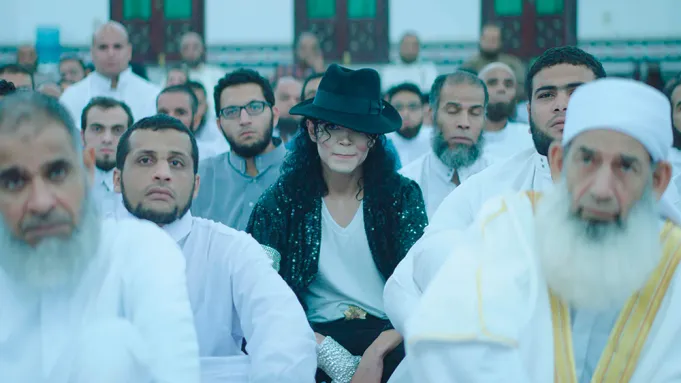
Egyptian pop culture has a really interesting relationship with Michael Jackson. It’s not just admiration from afar—it’s more like ongoing reinterpretation. His music and image kept getting pulled into very different Egyptian contexts, sometimes serious, sometimes comedic, but always adapted in a way that feels local.
Here are a few examples that show how that played out.
Sheikh Jackson Movie
In Sheikh Jackson, Michael Jackson becomes part of a deeper personal and cultural tension.
The story follows a Salafi preacher who once idolized Jackson as a teenager—copying his dance moves, his style, even being nicknamed after him. Years later, after Jackson’s death, those memories resurface and start clashing with the strict identity he’s built for himself.
What makes the film work is that it doesn’t treat Jackson as just a celebrity reference. He becomes a kind of emotional marker, representing a version of the self that was freer, more expressive, and maybe more uncertain. It’s really about identity under pressure, and how pop culture doesn’t just stay “external”—it sticks with people in unexpected ways.
“Two is Enough” Campaign
In the “Two is Enough” campaign, Akram Hosny takes “They Don’t Care About Us” and reworks it into a Sa‘eedi-style version.
The melody is still recognizable, but the rhythm, accent, and delivery shift completely. It’s translating the energy of the song into a different cultural register.
It shows how global pop can be reshaped without losing its identity, just filtered through a very specific Egyptian voice.
Osama Abbas in “Laylat El Qabd Ala Bakiza Wa Zaghloul”
In Laylat El Qabd Ala Bakiza Wa Zaghloul, Osama Abbas uses Michael Jackson-style movement as part of a comedic moment to Bakiza and Zaghloul’s dismay.
The reference is already shared cultural knowledge. The performance works because Jackson’s movement vocabulary has become universal shorthand for exaggeration, flair, or just playful coolness.
Shared post on Time
Entesh w Egry
“Entesh w Egry” is a more grassroots moment.
An Egyptian performer covers “Smooth Criminal” in a way that’s shaped entirely by his own environment—accent, delivery, physicality, everything.
He transformed it into something raw, funny, and uniquely local. The clip went viral because it felt authentic. It highlights how global icons like Jackson aren’t just consumed; they’re remade by everyday people.
Ali Rabee in Lahfa
When Ali Rabee appears in Lahfa doing Michael Jackson-inspired moves, the humor comes from timing and exaggeration rather than faithful recreation. Everyone watching already knows the reference, so the performance becomes a kind of cultural wink rather than a literal imitation.
Wrapping it up
Across all these moments, what stands out is how flexible Michael Jackson’s image becomes in Egyptian culture.
Sometimes he’s part of a serious reflection on identity. Sometimes he’s a tool for comedy. Sometimes he’s just a reference everyone instantly understands.
But in every case, he’s not treated as something distant or untouchable. He’s something people actively reshape—through language, humor, music, and memory.
And that’s probably the most interesting part: his influence doesn’t just travel to Egypt. It gets reworked there, in ways that feel entirely its own.
We Said This: Don’t Miss…When Michael Jackson Touched Down in the Arab World