
Close Menu
  • عربي
  • Arts
  • Thoughts
  • News
  • Travel
  • Tech
  • Events
  • Business
  • Food
  • Fashion
  • Health
  • Podcasts
  • Events Calendar
Facebook Instagram TikTok WhatsApp YouTube X (Twitter)
  • SCOOP EMPIRE
  • WARA EL MAZZIKA
  • WARA EL CEEMA
  • SCOOP CALENDAR
  • PODCASTS
  • عربي
Facebook X (Twitter) Instagram YouTube LinkedIn TikTok WhatsApp
Scoop EmpireScoop Empire
  • News
    This 11-Year-Old Egyptian Girl Just Won AED 500K at UAE’s Arab Reading Challenge
    October 29, 2026
    Is Netanyahu Staying in Power? Israel’s Election Explained 
    October 28, 2026
    UAE President Awards flydubai Crew for Their Actions During September Flight Incident
    October 28, 2026
    Adam Brody’s ‘Free Palestine’ Statement Sparks Backlash From Pro-Israel Figures
    October 25, 2026
    Pep Guardiola Calls for Solidarity With Palestinians Ahead of BDS Conference
    October 22, 2026
  • Arts
    The Egyptian Plays to Catch at Riyadh Season 2026
    October 29, 2026
    6 Egyptian Makeup Artists to Follow for Halloween Inspo
    October 26, 2026
    How Children’s Films From Gaza Inspired Animators Around the World
    October 26, 2026
    Muscat Art Exhibition Is Returning This October for Its Fifth Edition
    October 21, 2026
    Alana Hadid and Jenan Matari Withdraw Their Book on Palestine From Penguin Random House
    October 18, 2026
  • Events
    Public Art Abu Dhabi Biennial Is Turning Streets Into Art Canvases This November
    October 29, 2026
    CairoComix Festival Is Bringing Three Days of Comics and Creativity to Cairo
    October 25, 2026
    Muscat Art Exhibition Is Returning This October for Its Fifth Edition
    October 21, 2026
    Zayed National Museum Is Bringing 7,000 Years of Camel History to Life in a New Exhibition
    October 18, 2026
    Cairo Runners’ Annual Breast Cancer Run Returns to New Cairo This Friday
    October 14, 2026
  • Business
    FIX Dessert Wins Dubai-it Award After Taking Dubai Chocolate Global
    October 25, 2026
    What’s Happening in the Middle East’s Business World This October
    October 19, 2026
    How Meriem Mahrez Turned Her Hair Struggles Into ‘You Are Your Home’
    October 16, 2026
    10 Egyptian Companies That Made Forbes Middle East’s 2026 Fintech 50 List
    October 13, 2026
    Building Leaders, Not Just Careers: The Leadership Philosophy of Dr. Yomna Badr
    October 5, 2026
  • Food
    Coffee Creations in Egypt to Try When a Latte Just Won’t Cut It
    October 27, 2026
    5 Museum Restaurants in MENA Worth the Visit
    October 24, 2026
    Where to Get Your Halloween Desserts in Egypt
    October 22, 2026
    These Cairo Bakeries Serve Breakfast Worth Waking Up Early For
    October 16, 2026
    Fall Drinks Across the Middle East to Add to Your List
    October 15, 2026
  • Travel
    5 Museum Restaurants in MENA Worth the Visit
    October 24, 2026
    MENA Destinations Where You Might Experience Snowfall This Winter
    October 23, 2026
    Dubai’s Outdoor Season Is Back: Here’s Where to Go
    October 14, 2026
    6 Buildings Across the U.S. With Middle Eastern-Inspired Designs
    October 12, 2026
    8 Restaurants in Egypt Where the View Is Part of the Meal
    October 8, 2026
  • Fashion
    Gigi Hadid Steps Into Miu Miu’s Holiday Townhouse Fantasy in New Campaign
    October 28, 2026
    Pakistani Label ‘Dreams of Arthur’ Displays Pro-Palestine Message on the Runway
    October 27, 2026
    6 Dubai Fashion Week SS27 Collections That Had Us Looking Twice
    October 26, 2026
    A Little Bit Bambi: How to Style This Season’s Whimsical Print
    October 24, 2026
    Kate Middleton Just Added Another Elie Saab Look to Her Royal Wardrobe
    October 21, 2026
  • Health
    How Meriem Mahrez Turned Her Hair Struggles Into ‘You Are Your Home’
    October 16, 2026
    Cairo Runners’ Annual Breast Cancer Run Returns to New Cairo This Friday
    October 14, 2026
    6 Middle Eastern Food Spots Turning Pink for Breast Cancer Awareness Month 
    October 8, 2026
    7 Gyms in Egypt to Visit If You’re Ready to Take Fitness Seriously
    September 8, 2026
    Supplements on a Budget & the Stores That Stock Them
    August 21, 2026
  • Sports
    All the Records Lamine Yamal Has Broken Before 20
    October 27, 2026
    Egypt’s Hossam Hassan, Ibrahim Hassan, and Zico Face FIFA Bans
    October 20, 2026
    Palestinian Karate Champion Mariam Bsharat Wins Back-to-Back World Titles
    October 19, 2026
    Mohamed Salah’s Biggest Achievements Since Joining Trabzonspor
    October 12, 2026
    Syria Hosts the Arab Cycling Championship Again After Nearly 20 Years
    October 5, 2026
  • Tech
    6 Egyptians Nominated for the Women in Tech MENA Awards 2026
    October 20, 2026
    WHOOP Just Launched Its App in Arabic: Here’s What to Know
    October 14, 2026
    10 Egyptian Companies That Made Forbes Middle East’s 2026 Fintech 50 List
    October 13, 2026
    AI Teacher Avatars Could Soon Be Coming to Schools in Dubai
    September 28, 2026
    Meet the Robots Turning the Middle East Into a Sci-Fi Movie
    September 25, 2026
  • Thoughts
    11 Guinness World Records Set by Arabs in 2026
    October 17, 2026
    Why These Egyptian TV Villains Keep Stealing the Spotlight
    October 3, 2026
    How One Gazan Artist Is Bringing Color to UNICEF School Bags
    October 2, 2026
    Florence Pugh Opens Up About Her Continued Support for Palestine
    September 27, 2026
    How Gazans Are Finding Ways to Hold On to Everyday Life
    September 16, 2026
Scoop EmpireScoop Empire
You are at:Home»Business»Egyptian Coins Throughout the Ages
Business

Egyptian Coins Throughout the Ages

Thomas PinnBy Thomas PinnJuly 4, 20229 Mins Read
Facebook WhatsApp Twitter LinkedIn Pinterest Email
Egyptian Coins Throughout the Ages
Share
Facebook Twitter LinkedIn Pinterest WhatsApp Email

With pictures of pharaohs and grand Islamic and ancient Egyptian monuments, Egyptian currency is well known for being pretty darn cool. However, the humble Egyptian pound is only the most recent currency that Egypt has used and Egyptian coins can be traced back all the way through the Islamic, Byzantine, Roman, and Ptolemaic periods all the way until 360 BC. Here, we take a look back at Egyptian coins throughout the ages to see how they have changed

Back in 360 BC during the reign of Pharaoh Teos and later Nactanebo II, Egypt’s first minted currency was issued. The coin was called a nefer-nub in Egyptian, which translates into fine gold, and was referred to by the Greeks as a stater. However, these gold coins can’t be considered as currency in the full meaning of the term as they were created by the ruling pharaoh to pay Greek mercenaries and not for general commerce.

Via Wikipedia. Gold stater daric with a horse one one side and the hieroglyphics for nefer-nib on the other.

During the Ptolemaic period, coinage that was meant to be used as a standard currency was first introduced. With coins being produced in Memphis and then Alexandria, great efforts were made to instil the use of currency in Egypt under Ptolemy II Philadelphus. In addition, foreign currencies were confiscated and a strict policy of a single currency was enforced. Surprisingly, silver was actually rarer and thus more expensive than gold during this period, and as such became an obvious choice to make a coin.
Advertisement
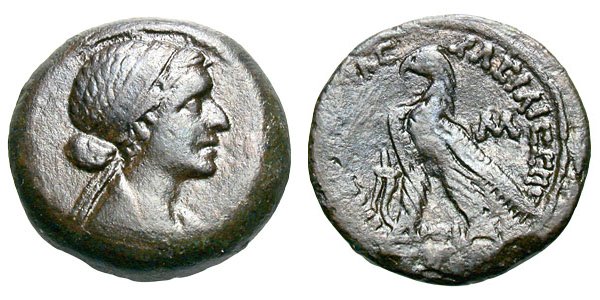
Via Wikipedia. 40 drachms showing Cleopatra VII on one side and an eagle on the other.

In the Ptolemaic period, bronze was also later used for coins and one such bronze coin weighed an incredible 100 grams. As Ptolemaic rule came to an end, Egypt had been transformed from a country that mostly relied on exchange and barter for commerce to one largely that used an official currency in its economy. This had the added effect of enabling effective taxation and trade, which created the basis for an affective and flexible state.

Via Wikipedia. Bronze coin showing Ptolemy V Epiphanes on one side and an eagle on the other.

With the start of the Roman period in Egypt, the use of Ptolemaic coins continued for quite some time as Rome decided to slowly phase out local currencies to avoid unnecessary complications. Ptolemaic silver coins were eventually phased out of circulation, melted down and turned into Roman coinage.

Via Wikipedia. Drachma from Alexandria showing Alexander Severus on one side and the Greek god of medicine, Asclepius, on the other.

Egypt’s monetary system remained a closed and isolated currency based on the tetradrachm until 297 AD, when Egypt’s currency was finally brought in line with the rest of the Roman Empire by Diocletian. The period following this saw the use of the same currency as used all over the Roman Empire

Via Wikipedia. Coin depicting Hadrian on one side and the Roman version of the god Isis on the other.

Byzantine rule in Egypt saw the use of coins that replaced Roman religious imagery with Christian imagery. However, the Byzantines carried on the convention of displaying the ruling emperor and maintained a similar system of weights.

Via Wikipedia. A half folis showing Justinian I on one side and the K on the other, which was a Greek symbol for 20.

The Islamic conquest of Egypt from 639 AD until 646 AD put an end to Byzantine rule; however, in Egypt, as in Syria, the use of Byzantine currency was continued. Likewise on the other side of the caliphate in Iran and Iraq, the use of Sassanian coins similarly continued for some time. However, imitation Byzantine coins were also produced in the Islamic world that were identical in weight and gold quality. While these coins minted in the Islamic caliphate continued to depict the Byzantine figures, there were small changes made such as the Greek inscription MACP, for the Arabic word for Egypt, misr. Additionally, some of the Christian iconography was either removed or replaced with Islamic symbols, for example, on one common coin, the three standing figures had their crucifixes replaced with orbs, while on the other side the original text was replaced with the Islamic declaration of faith in Arabic.

Via NumisBids. De-Christianised imitation of a Byzantine coin created during the early period of the Islamic empire.

In 697 CE during the Umayyad Caliphate, Caliph Abd al-Malik ibn Marwan created the first truly Islamic coin, which in no way sought to imitate either Byzantine or Sassanid coins as had been done before. The new coins were devoid of all visual imagery and instead had verses of the Qur’an. The caliph banned the use of any other currency throughout the Umayyad Caliphate and enforced this with the death penalty.
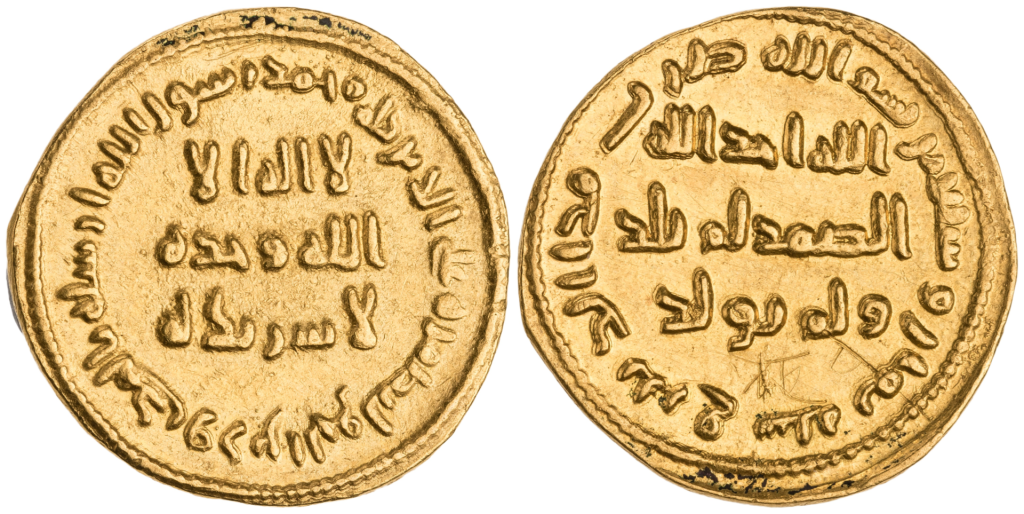
Via Wikipedia. Umayyad coin from 697 CE

Throughout the rest of the Umayyad and Abbasid caliphate, only small changes were made to the coinage, usually involving the design, script and the caliph or governor mentioned. However, for a brief period during Fatimid rule, some coins were introduced that stated Shi’a doctorine, but were quickly removed due to the anger it caused in the mostly Sunni country.

Via Wikipedia. Dinar produced by Fatimid Caliph Al-Mu’izz li-Din Allah

Following this, the Abbuyid and Mamuluk periods continued the same core conventions for its coinage. However, these relatively unchanged conventions dictating coin design for 820 years abruptly ended in year 1517 with the Ottoman invasion of Egypt.

Via Wikipedia. Dinar produced under the reign of Sultan Baybars.

The Ottomon invasion of Egypt and the overthrow of the Mamluks led to the introduction of a new minted currency that was controlled by the Ottoman Empire called the para. Following the invasion in 1517, the new currency was formally introduced in 1524 along with its set standards, weights and references to the ruling sultans.

Via NumisBids. Coin produced under the reign of Selim III and minted in Cairo
Via Numista. One Qirsh issued under the reign of Mahmud II.

As part of Khedive Muhammed Ali’s reforms to modernise Egypt, Egypt’s monetary system was also shaken up with the introduction of a new currency in 1834, the Egyptian pound. Although the currency is still used today, the coinage and banknotes went through several design changes over the years reflecting Egypt’s modern history as kings came and went, followed by the post-revolutionary period that sought to do away with depictions of leaders, bar the occasional commemorative coin.

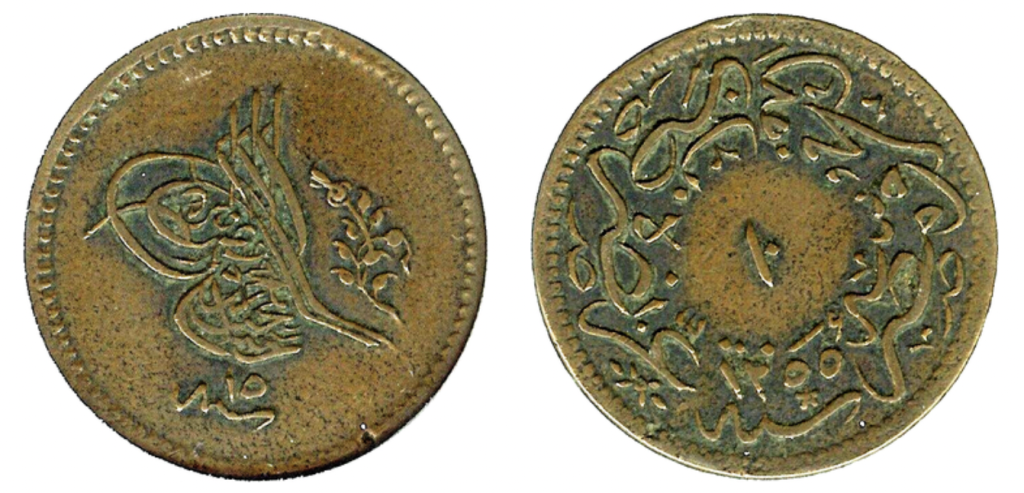
Via Numista. Coin issued under the rule of Sultan Abdul Hamid II
Via Numista. Coin minted under the reign of Sultan Abdulmejid I
Via Numista. Coin issued under the reign of Sultan Mehmed V

As the Ottoman Empire began to crumble following its defeat in the First World War, Egypt was declared a formal protectorate of the British Empire and the Ottoman Empire, which was soon to fully dissolve in 1922, suddenly had no influence or control over Egypt. Egypt’s ruling elite were keen to distance itself from its former Ottoman rulers, and Sultan Hussien Kamel issued a new set of coins that did away with references to the Ottoman sultan, and instead replaced this with the name of Egypt’s current ruler.
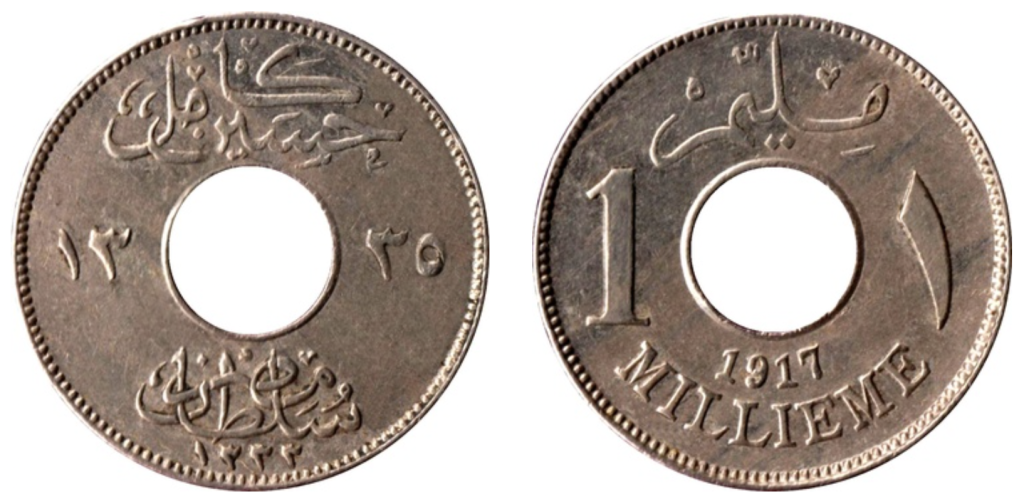
Via Numista. Coin issued under the reign of Sultan Hussein Kamil.

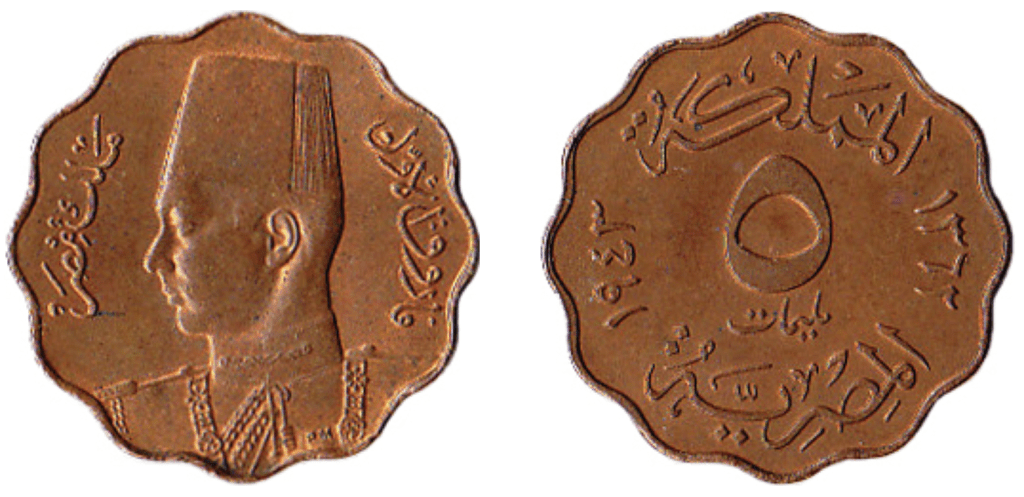
Starting with King Fuad and ending soon with the 1952 revolution overthrowing the Egyptian monarchy, coins started portraying the current king in profile. These coins stylistically were very similar to British coins, aiming symbolise a similar imperial prowess and a dominant monetary system.

Via Numista. Coin issued in 1932 under the reign of King Fuad
Via Numista. Coin issued in 1943 under the reign of King Farouk.
Via Numista. Coin issued in 1944 under the Reign of King Farouk

Following the overthrow of the monarchy in 1952, Egypt became a republic and began a campaign to remove any and all symbols of the previous ruling monarchy. Coins were an obvious target of this campaign as the images of kings projected royal power and authority. However, Egypt introduced a new set of coins following the revolution that did away with the portrayal of leaders altogether, and instead replaced them with images celebrating Egyptian history, culture and the memorialisation of certain events.
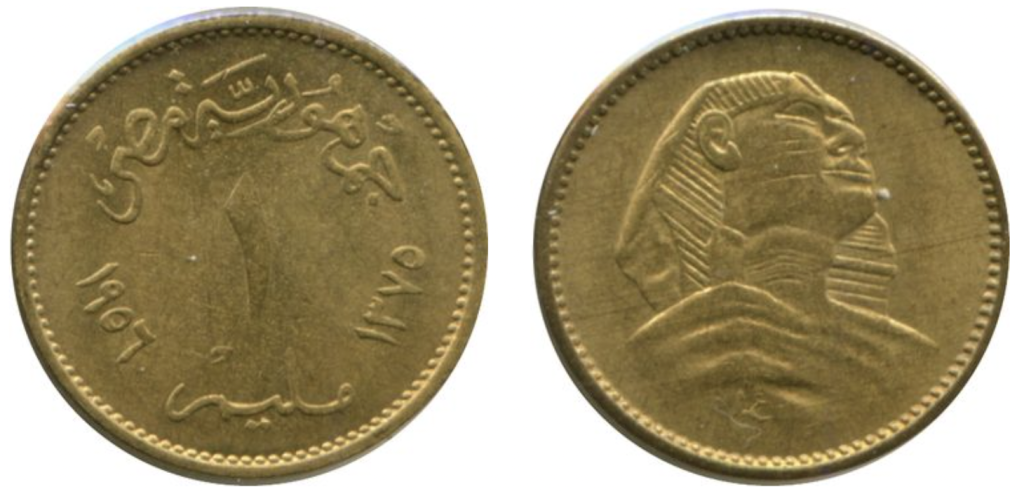
Via Numista. Coin issued in 1956 with Republic of Egypt written.
Via Numista. Coin issued in 1956 commemorating the evacuation of British forces from the Suez Canal zone in 1956.

For a brief period between 1958 and 1961, Egypt and Syria became one country known as the United Arab Republic. Meant to be the first step in creating a pan-Aran state incorporating the whole region, this period represents the peak of Arab nationalist aspirations and was accompanied by the minting of new coins with the coat of arms of the United Arab Republic.
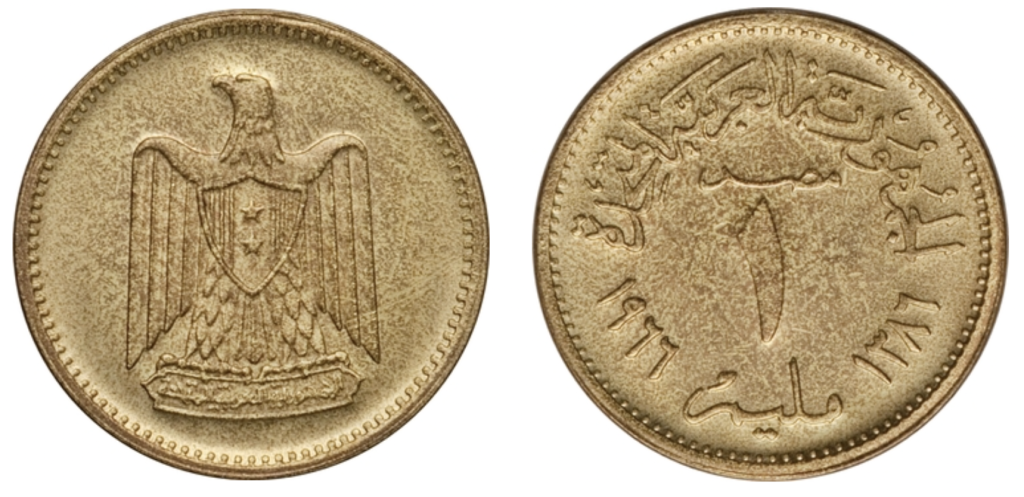
Via Numista. Coin issued in 1966 with the coat of arms of the United Arab Republic on one side and United Arab Republic written on the other.

Modern Egyptian coinage also saw the introduction of numerous commemorative coins that were put into circulation that celebrated the nation’s achievements and commemorated events and people. Events like the completion of the Aswan Dam were celebrated and Egypt’s wars remembered among many other notable events.

Via Numista. Coin issued in 1973 commemorating the opening of the Aswan Dam.
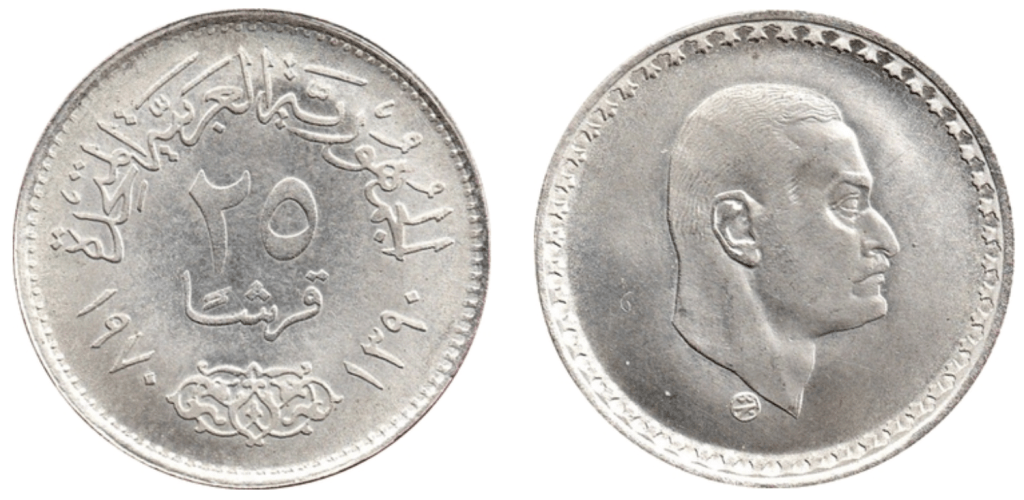
Via Numista. Coin issued in 1970 commemorating President Gamal Abdul Nasser, who died the same year.
Via Numista. Coin issued in 1974 commemorating the 6th October War.
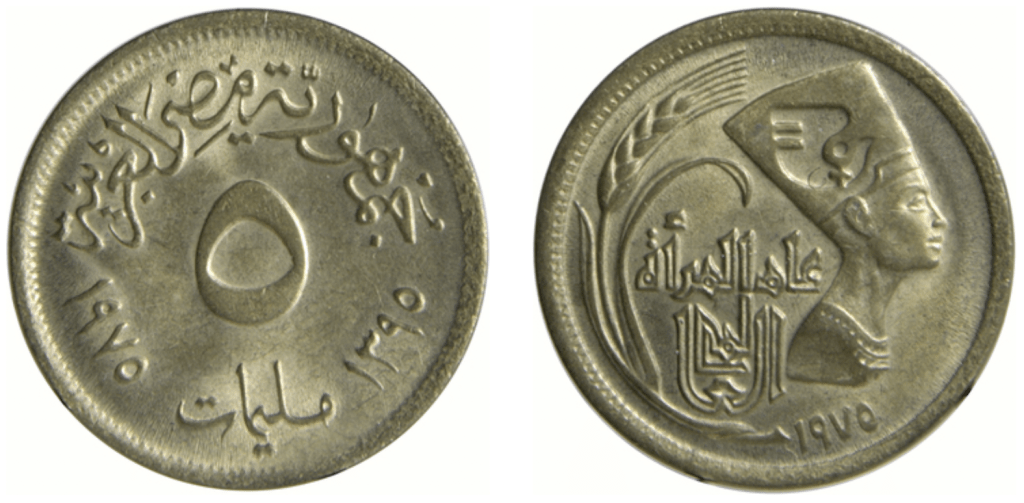
Via Numista. Coin issued in 1975 commemorating the International Year of the Woman.
Via Numisa. Coin issued in 1991 depicting the Great Pyramids of Giza.
Via Numista. Coin issued in 2004 depicting a glass lantern.

Egypt’s modern coinage that we know today occasionally commemorates certain events like the Pharaoh’s Golden Parade or celebrates certain people like the heroic actions of medical staff during the COVID-19 pandemic. However, most of the coins show the mask of Tutankhamen in a nod to the country’s pharaonic past and represent the history of Egyptian coinage coming full circle.

Via Numista. One Egyptian pound issued in 2010 depicting the mask of Tutankhamun.
Via Numista. One Egyptian point coin issued in 2021 commemorating the Pharaoh’s Golden Parade.
Via Numista. Coin issued in 2020 honouring the work and sacrifices of medical staff during the COVID-19 pandemic.

WE SAID THIS… Egypt’s New Eco-Friendly Plastic Currency To Circulate Starting Early November 2021

coinage Coins Egypt egyptian coinage Egyptian coins egyptian currency egyptian money Middle East
Previous ArticleMarshmello, Disco Misr, and Nancy Ajram To Perform at Gamers8 Festival
Next Article UAE And Netherlands Partner Up to Develop The World’s First Solar-Powered Car 
Thomas Pinn
  • Facebook
  • X (Twitter)
  • Instagram

Thomas can often be found taking walks throughout Cairo in search of the weird and wonderful. He is interested in local histories and is studying for a Master's in international relations with a particular focus on Cairene urban development and heritage conservation.

Advertisement

Related Posts

This 11-Year-Old Egyptian Girl Just Won AED 500K at UAE’s Arab Reading Challenge

October 29, 2026

Public Art Abu Dhabi Biennial Is Turning Streets Into Art Canvases This November

October 29, 2026

Gigi Hadid Steps Into Miu Miu’s Holiday Townhouse Fantasy in New Campaign

October 28, 2026

Comments are closed.

Business events in MENA

  • 30OctAI for Social Impact at Beirut Digital DistrictBeirut · Beirut Digital District11:00 am
  • 30OctRCPIE Beirut 2025 – Phoenicia Beirut HotelBeirut · Phoenicia Beirut Hotel4:00 pm
  • 2NovSaudi Elenex 2026Riyadh · Riyadh International Convention and Exhibition Center12:00 am
  • 2NovSaudi FNPOS 2026Riyadh · KAFD1:00 pm
  • 3NovIPEM Future DubaiDubai · The Atrium, DIFC9:30 am
See all upcoming events →
Follow Us
  • Facebook
  • Instagram
  • TikTok
  • YouTube
  • Twitter
  • WhatsApp
  • LinkedIn
Advertisement
Scoop Empire

Stories from the Middle East

Facebook Instagram TikTok YouTube WhatsApp X (Twitter) LinkedIn

Sections

  • News
  • Arts
  • Events
  • Business
  • Food
  • Travel
  • Fashion
  • Health
  • Sports
  • Tech
  • Thoughts

More

  • About
  • Contact Us
  • Scoop Team
  • Careers
  • Terms & Conditions
  • Privacy Policy
  • بالعربي

© 2026 Scoop Empire. Made in Cairo with ♥︎.

Scoop Empire Universe

Type above and press Enter to search. Press Esc to cancel.