


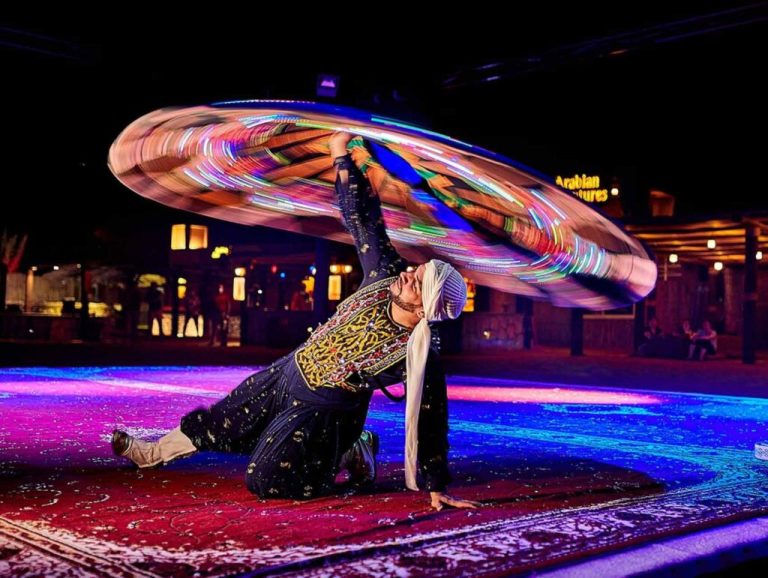
Tanoura performances have long held us spellbound, especially during the holy month of Ramadan. Every year, we watch the swirling colors, flashing lights, and hypnotizing movements, often finding ourselves wondering, “How do they never get dizzy?” Beyond the spectacle, this captivating tradition carries a rich history and intricate details, weaved into Egyptian folklore.
The Origins of the Spin
The dance is believed to have its roots in the Sufi practice of The whirling Dervishes, a spiritual tradition within Islamic mysticism. It originated in the 13th century and was popularized by Turkish Sufi scholar and poet Jalal al-Din al-Rumi as a form of moving meditation, designed to elevate the soul and bring practitioners closer to God.

How It Made Its Way to Egypt
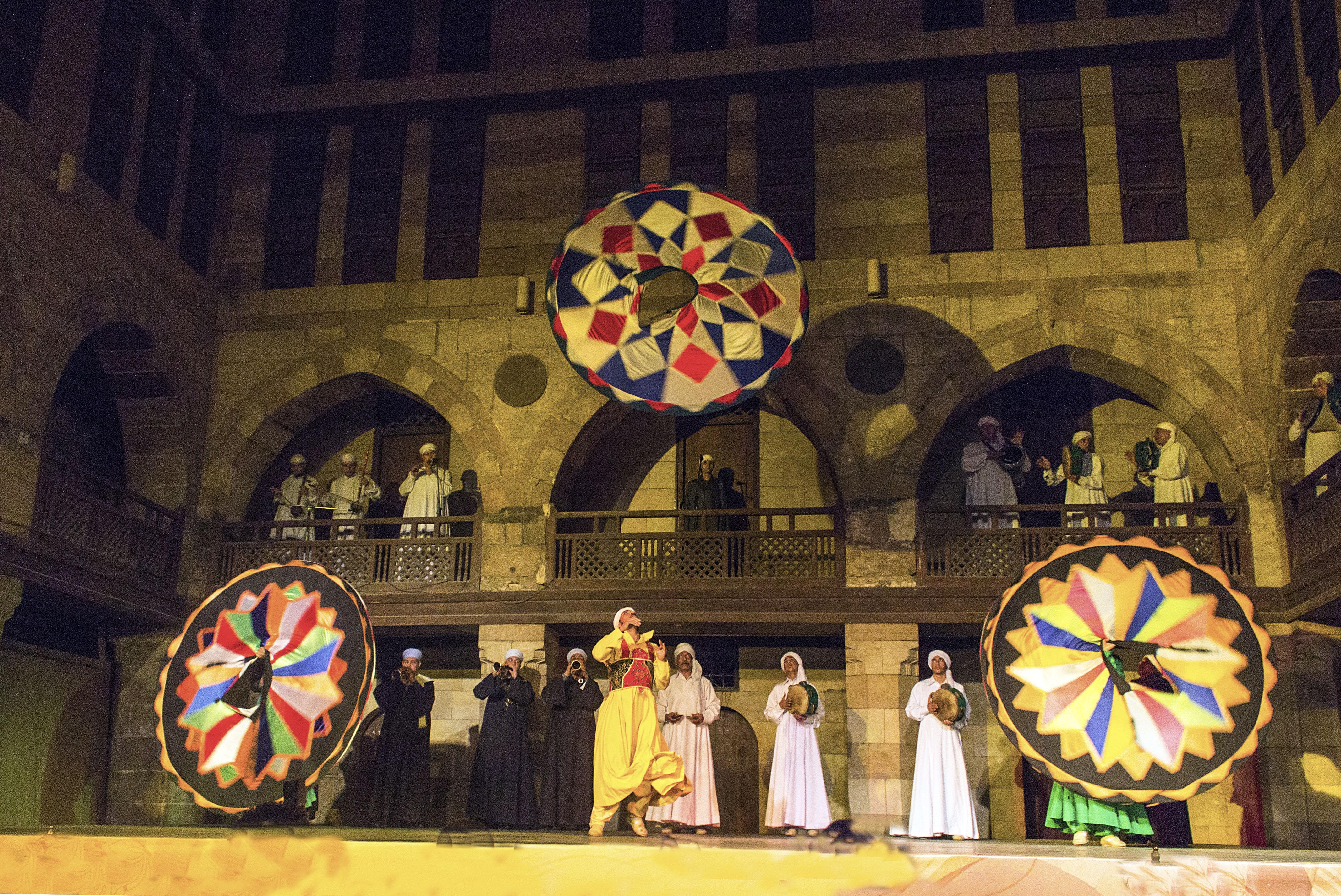
The tradition was first introduced to Egypt during the Fatimid era, where it was given the name Tanoura, which is Arabic for “skirt.” Over time, it spread beyond Sufi circles and evolved into a vibrant theatrical performance. The tradition endures to this day, most notably in shows at the Al-Ghouri Complex in Old Cairo, celebrated for their dazzling colors, hypnotic spins, and artistic flair.
The Secret to Endless Whirling
Performers spin anti-clockwise, opposite to the direction of blood circulation, to help prevent dizziness, according to an interview with The Egypt Gazette, finally answering the question that has crossed our minds at least once. It’s one of the key techniques Tanoura dancers rely on, and with focused training, some can master it in as little as a week.
![Tanoura Show in Cairo [2026] Epic Cultural Experience](https://www.egypttoursplus.com/wp-content/uploads/2025/07/Tanoura-Show.jpg)
The Symbolism Behind the Movement
The endless circular motion of the Tanoura symbolizes the movement of the universe and the rhythm of life itself. As the dancer spins, he embodies the planets in orbit, telling a spiritual story that reflects humanity’s connection to the divine. The two layers of the Tanoura skirt, which separate during the performance, represent the sky and the Earth, while the beginning of the dance signifies a time when the heavens and the Earth were still one.

Tanoura in Egyptian Film
This folk art also played a central role in Alwan El Sama El Sab’a (2007), a film that drew attention for its unique storytelling and continues to resonate to this day. In the movie, Bakr (Farouk El Fishawy) is a Sufi Tanoura dancer who falls in love with Hanan (Laila Eloui), a woman from his audience in Ramadan. The story weaves romance into the authentic Egyptian culture.

Tanoura isn’t just a dance; it’s a celebration of culture, spirituality, and art. Every swirl tells a story, connecting the past to the present and reminding us why this hypnotic tradition continues to captivate audiences, especially during the magic of Ramadan.
We Said This: Don’t Miss… 8 Ramadan Shows Bringing Real Drama to the Forefront of Our TV Screens