


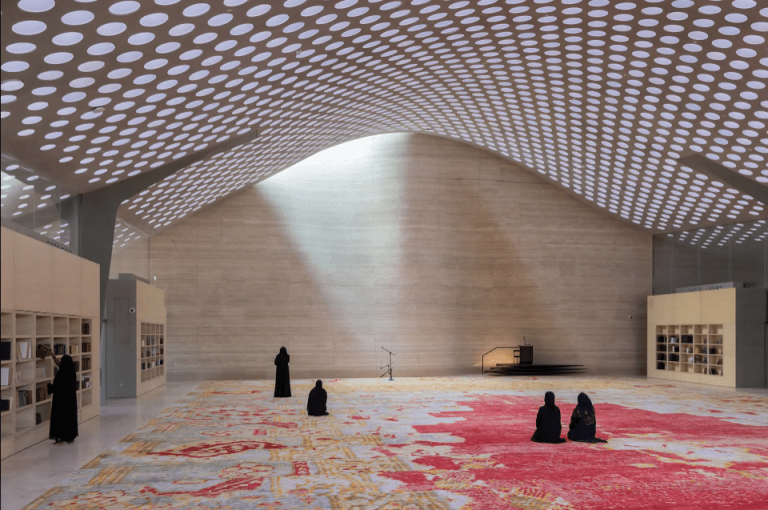
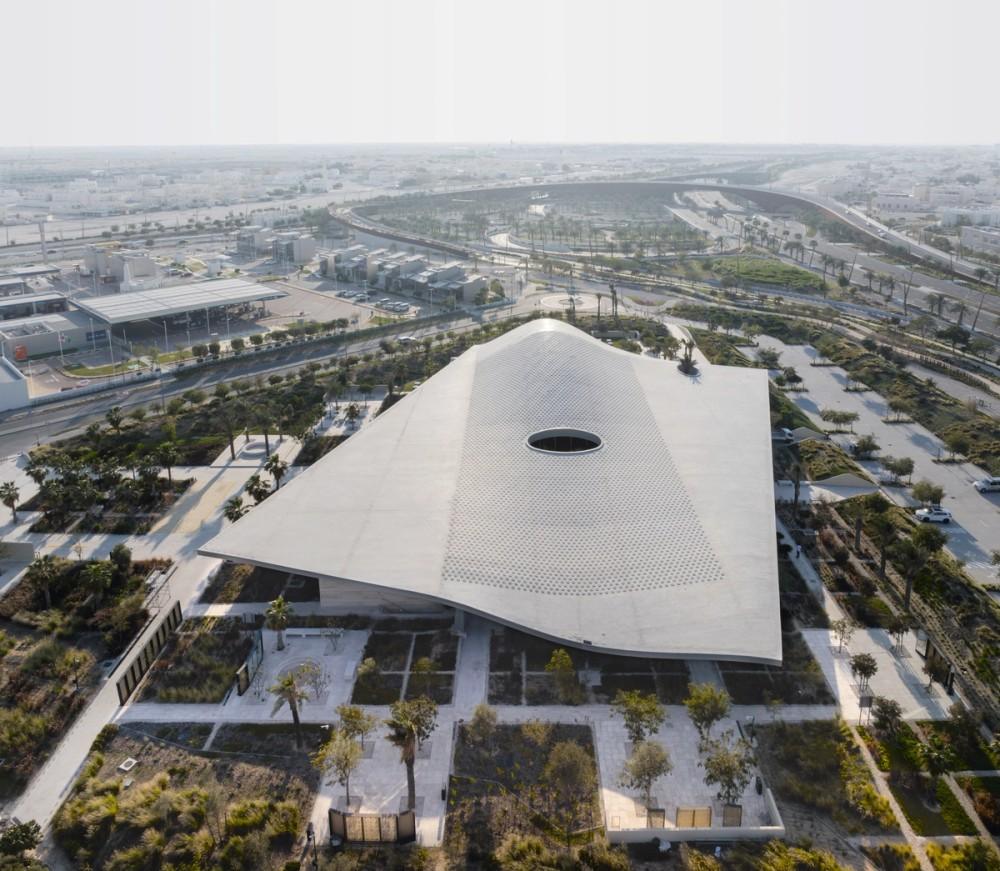
Over the past few days, Al-Mujadilah mosque has been making headlines. Nestled in Qatar’s Education City, it is the first purpose-built contemporary women’s mosque in the Muslim world, a space where worship, learning, and community all revolve around women. But the story behind its name, its design, and its mission is what makes it truly remarkable.
Why “Al-Mujadilah”?
The name comes from Surat Al-Mujadilah, or “She Who Discourses.” In the Qur’an, this chapter was revealed in response to Khawla bint Tha’labah, a companion of the Prophet ﷺ, who faced an impossible situation when her husband pronounced zihar, saying, “You are to me as my mother.” In pre-Islamic Arabia, this was effectively a form of divorce that left women with little recourse.
Instead of quietly accepting her fate, Khawla went to the Prophet ﷺ. By addressing her grievance directly, God affirmed that her grievance mattered, and her courage changed legal and social norms.
“Indeed, Allah has heard the argument of the woman who pleaded with you ˹O Prophet˺ concerning her husband, and appealed to Allah. Allah has heard your exchange.1 Surely Allah is All-Hearing, All-Seeing.” (Qur’an, 58:1)
The rest of the Surat goes on to clarify the rules around zihar, offering protections for women and changing the law forever.
The mosque is reclaiming the word mujadilah, which is often used with negative undertone. Speaking up, questioning, and seeking justice is shown as not only acceptable but necessary.
A Space Designed for Women
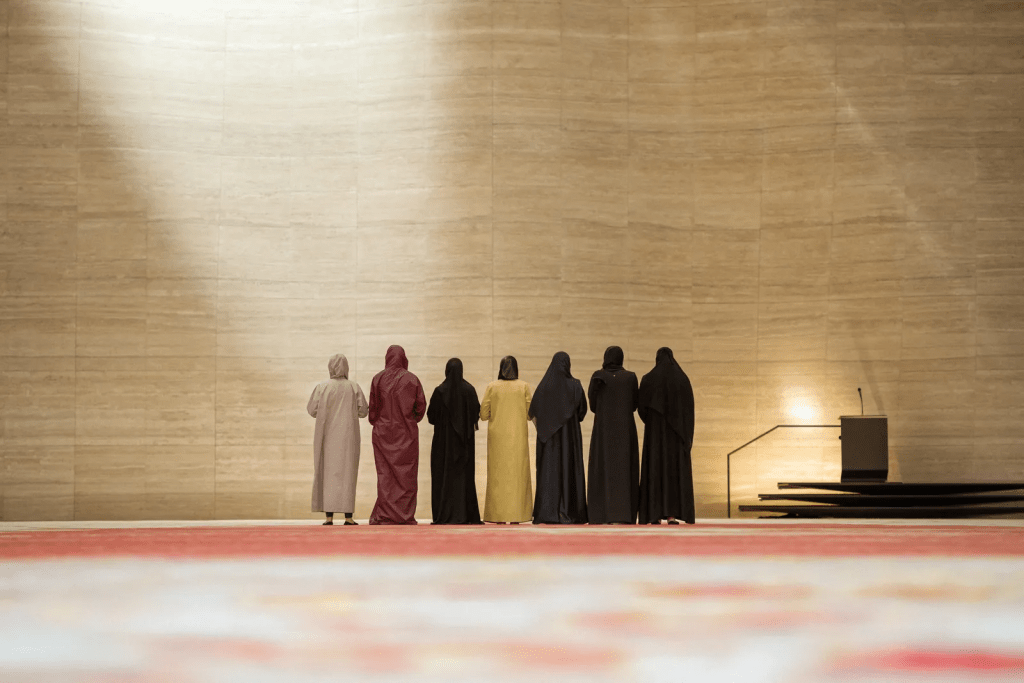
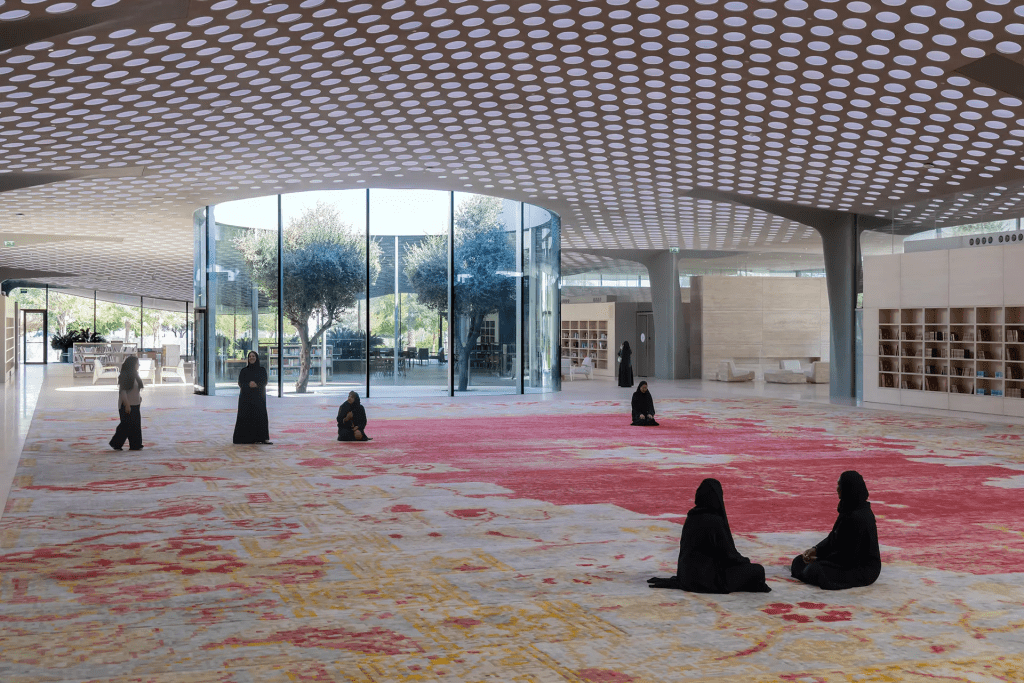
Traditional mosques often dedicate only a small portion of their space to women, around 25%, and in some cases, women are excluded entirely. Al-Mujadilah flips that entirely. The prayer hall accommodates up to 750 worshippers, expanding to 1,300 during Ramadan.
Its undulating Qibla wall draws the eye naturally toward the mihrab and minbar, while 5,488 skylights filter soft, diffuse light into the hall. Two olive trees pierce the roof, connecting the sacred interior to nature and tradition.
The mosque’s design was conceived by Her Highness Sheikha Moza bint Nasser, and was led by Elizabeth Diller of Diller Scofidio + Renfro, with project management by Maha Al-Khalifa, a reminder that women shaped every aspect of this space.
Women as Contributors to Knowledge
The mosque is all about voice and knowledge. Khawla bint Tha’labah’s story shows that women have always shaped law, faith, and society. Today, that legacy continues.
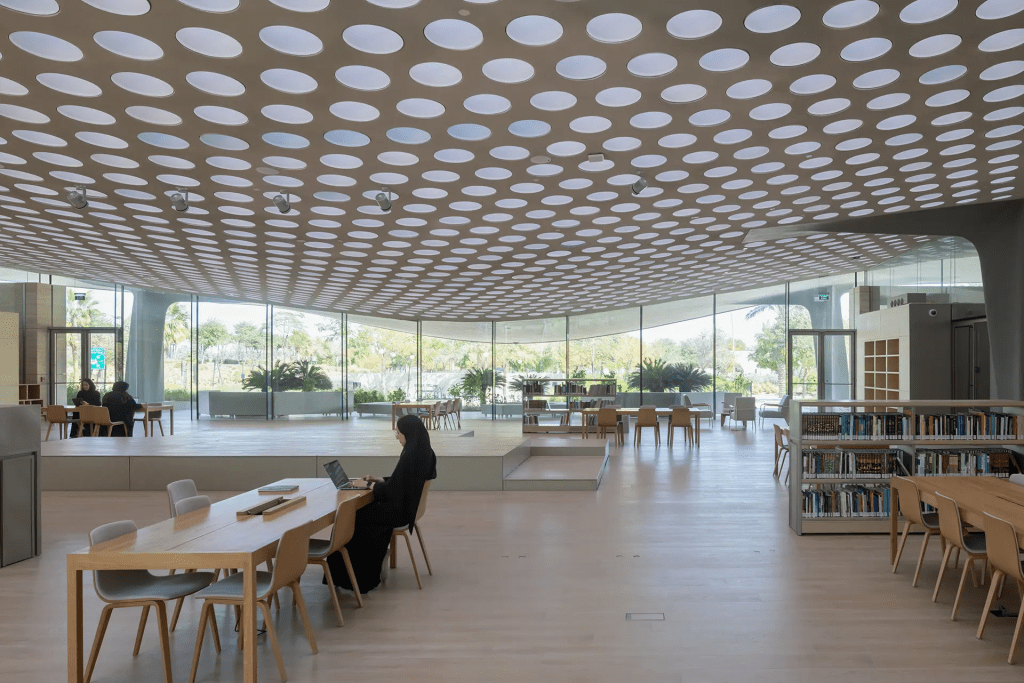
The mosque includes flexible classrooms and a library of over 8,000 volumes, including works on Islamic history, women’s contributions, and literature by Muslim female authors.
Through the library, classrooms, and programs like the Jadal Summit, women study, debate, and actively contribute to Islamic thought. In this way, Al-Mujadilah embodies the same principle: women are not just participants, they are producers of knowledge.
Continuing the Legacy
Al-Mujadilah is a space where women lead, learn, and engage. Prayers are led by women, classes are tailored for women, and the architecture itself was shaped by women.
Programs encourage Quran study, personal growth, and public engagement. It’s a space where faith, scholarship, and community meet.
In Conclusion
Al-Mujadilah stands as a beacon of inclusion, learning, and faith. It honors Khawla bint Tha’labah, celebrates women as knowledge contributors, and subtly reclaims a word that has often been used to criticize women. Here, prayer, study, and dialogue coexist, showing that a woman’s voice is powerful and transformative, just as God intended.
WE ALSO SAID: Don’t Miss…From Temple to Church to Mosque: How One Luxor Site Changed Through Time